Fig Bonsai: Full Guide, Sweet Fruit, Small Leaves

FIG BONSAI

The Fig Bonsai: A Taste of the Mediterranean

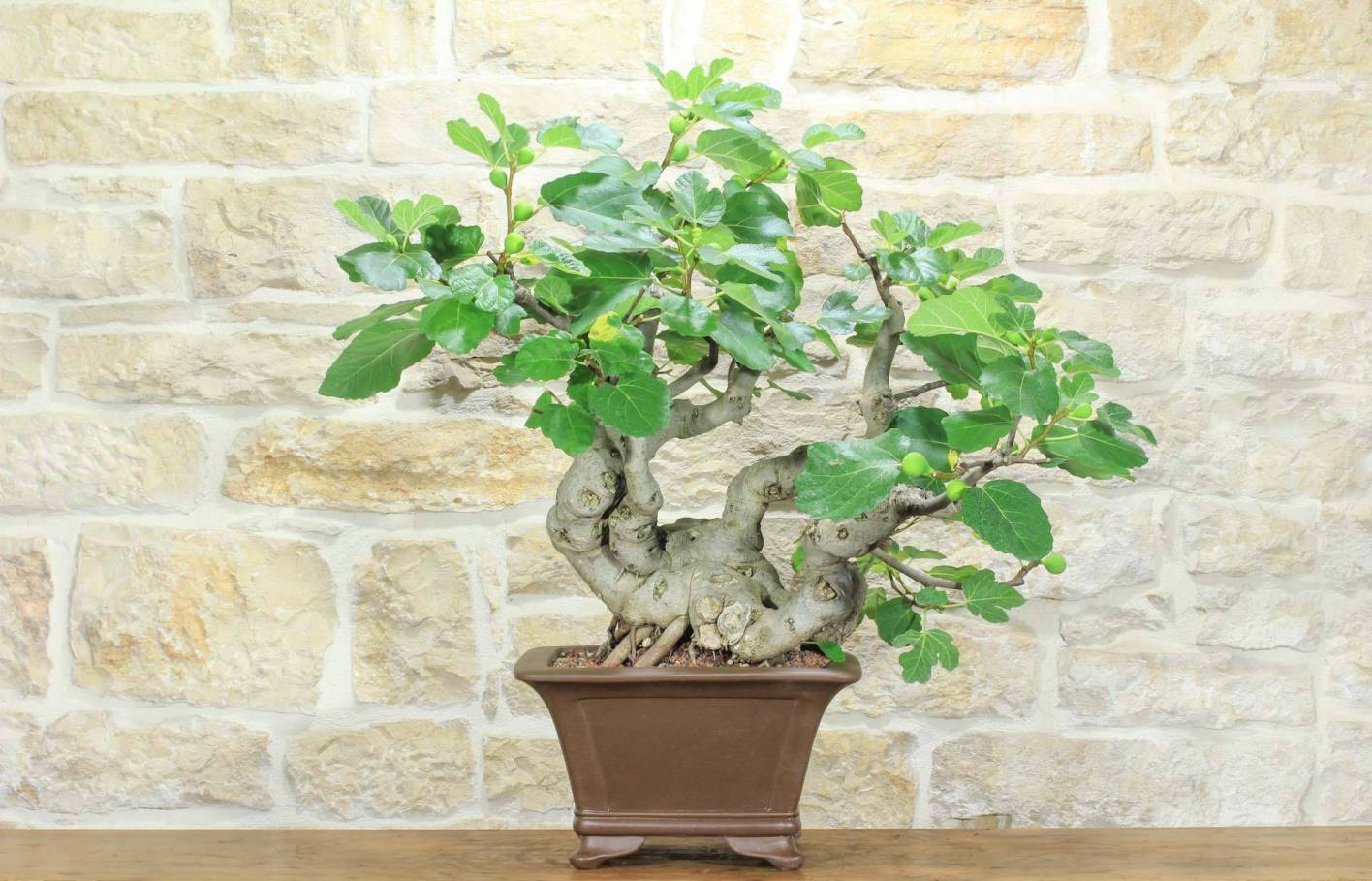
The common fig (Ficus carica) is a highly rewarding bonsai, able to conjure up sun-baked landscapes and dry-stone walls at a glance. Unlike the tropical figs (such as Retusa or Ginseng), our native fig is a deciduous plant: it drops its leaves in winter, revealing a beautiful smooth, pale grey bark and a ramification that can become very striking. The main challenge with this species is reducing the naturally large leaves, but with the right technique you obtain well-proportioned results and, above all, edible fruit in miniature.

Origin & species

Native to Caria (a region of Asia Minor, hence the name carica) and spread throughout the Mediterranean for millennia. It belongs to the Moraceae family. It is a tough tree, almost invasive in the wild thanks to its ability to root anywhere. For bonsai, varieties with small fruit or more deeply lobed leaves are preferred, but the wild common fig is also excellent to start with.

Position and microclimate

The fig demands full sun.
Direct sunlight is the only real "secret" to shrinking the leaves and shortening the internodes. Kept in the shade, the leaves will become enormous and the branches long and weak.
It loves heat and air movement. In summer it tolerates scorching temperatures without problems, provided the roots do not "boil" inside a pot that is too small.

Watering

With large leaves that transpire heavily, the fig drinks a great deal in summer.
Water generously as soon as the soil mix dries at the surface.
Be careful, however: if you want to reduce leaf size, you must not spoil it with water in spring while the buds are opening. Slight water control helps keep the leaves compact. Avoid waterlogging at all costs: the fleshy roots rot quickly.

Water quality

It is an extremely tolerant plant.
It accepts tap water, even hard water. It needs no special water, being used to growing on poor, rocky soils.

Substrate

It requires a free-draining but nutritious substrate.

  • Recommended mix: 50% pumice (or Akadama), 30% lava rock and 20% universal soil mix or humus.
  • The organic component matters because the fig is a greedy plant that spends a lot of energy producing fruit and leaves.

Repotting

Carried out in spring (April), when the buds begin to swell.
Repot young plants every 2 years, older ones every 3-4.
The root system is extremely vigorous and fills the pot rapidly. You can be drastic when pruning the thick, woody roots; the fig produces new roots with great ease.

Fertilizing

Feed generously from spring to autumn.
In spring use a balanced organic fertilizer.
From June onwards, if you want to encourage the figs to ripen, use a fertilizer high in potassium (K). Avoid excess nitrogen if the leaves are already too large.

Flowering and fruiting

The fig has no visible "flower" in the classic sense: what we eat (the syconium) is in fact an enclosed inflorescence.
The fruits appear in summer and ripen in late summer/autumn.
On a bonsai, let only a few fruits (2-3) ripen so you can enjoy the purple or green colour, otherwise the plant will stop growing in order to feed the figs.

Structural pruning

Carried out in late winter.
Fig wood is soft and the pith is hollow or spongy.
Fundamental rule: when you cut a thick branch, cover it immediately with cut paste. If you leave the pith exposed, the branch will rot and hollow out internally right back to the main trunk. The cuts heal slowly.

Maintenance pruning (defoliation)

During the growing season, shorten the shoots to 2 nodes once they have made 5-6 leaves.
The key technique for the fig is defoliation in June. By cutting off all the leaves (leaving the petiole), you force the tree to produce new ones in midsummer: these will be much smaller and more numerous. Do this only on healthy plants.

Pinching

In spring, pinch the apical bud after the first 2-3 leaves have formed to stop the shoot from extending.

Wiring & bending

The branches are flexible when young, but watch the bark: it is smooth and delicate and marks immediately.
Also, every time you bend or cut, an irritating white latex will seep out.
Apply the wire in summer, but check it every fortnight because the branches thicken very quickly.

Diseases and pests

  • Scale insect: often attaches under the leaves or on the branches.
  • Red spider mite: in summer in hot, dry weather.
  • Fig fly: can attack the fruit and cause it to drop.

Winter & protection

In central and southern Italy it lives outdoors all year round.
In the north it is hardy, but the roots in a pot suffer from prolonged frost (the pot turns into a block of ice). Protect the pot with mulch or move it into a cold greenhouse if temperatures stay below -5°C for days.

Yearly calendar

  • January-February: structural pruning, sealing cuts.
  • March-April: repotting, start of fertilizing.
  • May: pinching, pest checks.
  • June: defoliation (to reduce leaf size), wiring.
  • July-August: plenty of water, fruit ripening.
  • September-October: autumn fertilizing (PK), remove wire.
  • November-December: leaf drop, dormancy.

Useful products for this bonsai


Frequently asked questions about the fig

Is the white latex poisonous?
It is irritating and phototoxic. If it gets on your skin and you then go out in the sun, it can cause burns or blotches. Wash your hands thoroughly after touching the latex and keep it away from your eyes.

How do I get small leaves?
Three rules: 1) full sun. 2) A small pot (which restricts the roots). 3) Complete defoliation in June. If you grow the fig in a large pot in the shade, the leaves will always stay enormous.

Why do the figs drop before ripening?
Usually it is a lack of water. The syconium (the fruit) is full of water; if the plant is thirsty it "drinks" the water from the fruit, which shrivels and falls. Water more while the fruit is on the tree.

404 Error

This page is no longer among our branches.

The page you are looking for may have been moved, removed, or is no longer available. But your next bonsai, accessory, or gardening item is still here waiting for you.

Explore the main categories or use the search below.
404

No problem: we will help you quickly find bonsai, pots, accessories, and useful content.

A reference point for bonsai and gardening lovers

Quickly find bonsai, gardening items, pots, accessories, and useful content to better take care of your plants.

Explore the catalog