




€390.00

Home
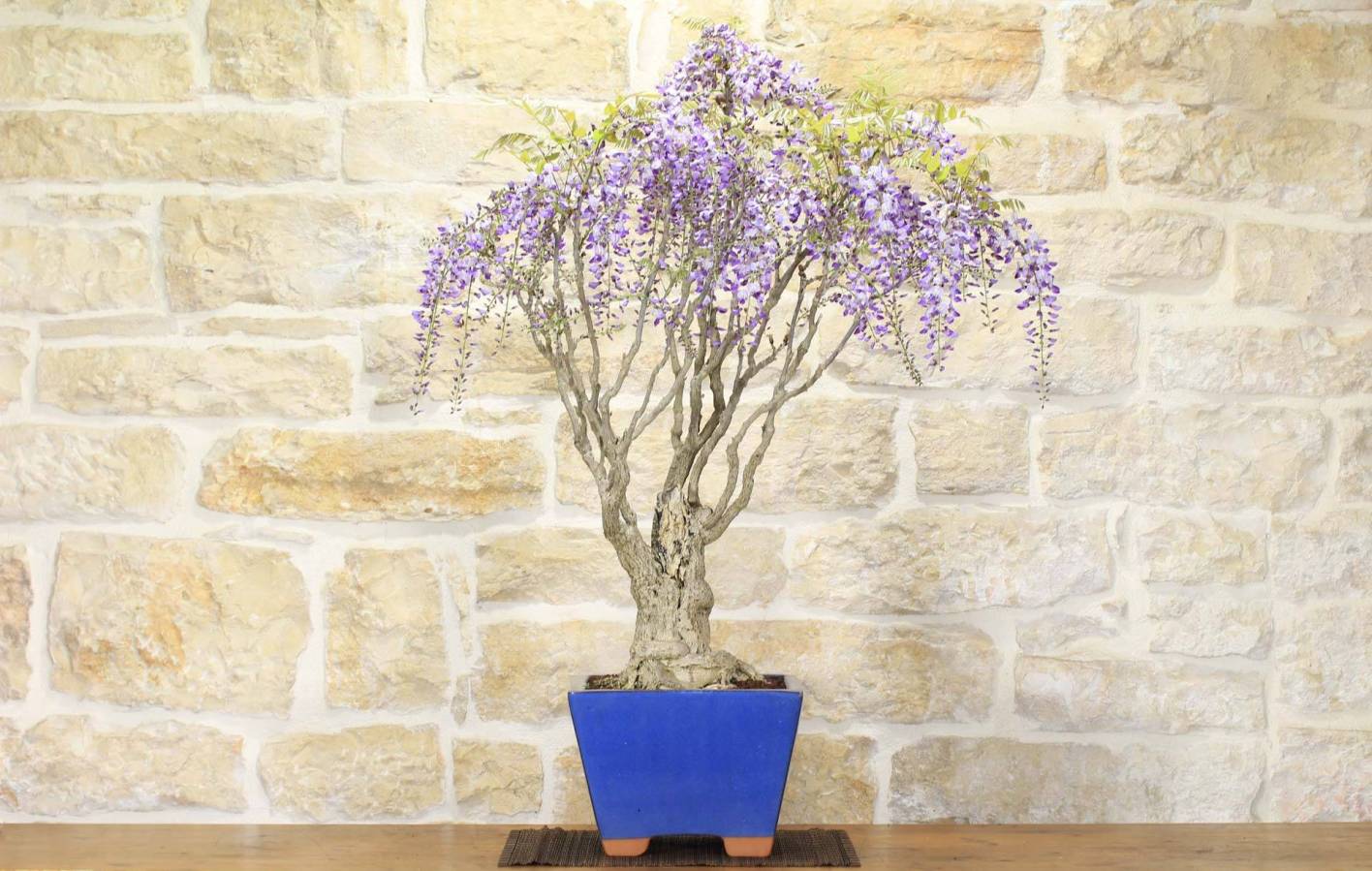
Wisteria (Wisteria floribunda or sinensis) is the spring bonsai par excellence. When it blooms, the coloured racemes (lilac, white or pink) hanging from the bare branches are a breathtaking sight. It is an extremely vigorous climber, almost invasive in the wild, which makes it easy to grow but demanding to keep in check as a bonsai. It is not grown for fine ramification (which is coarse), but for the elegance of the flowers and the charm of the twisted trunk.
Native to China and Japan (W. Sinensis and W. Floribunda respectively), it belongs to the Fabaceae family (legumes). The Japanese variety has longer, more elegant racemes and is often used for medium/large size bonsai. The trunk ages beautifully, becoming fluted and muscular.
Wisteria is a sun worshipper.
Full sun at all times. Sun is the fuel needed to set the flower buds for the following year. If you keep it in the shade, you will get plenty of green leaves and no flowers.
It does not mind heat, but in summer it drinks like a sponge.
In summer, Wisteria is one of the very few exceptions to the "no standing water" rule.
During flowering and in the hot months (June-August) it drinks so much that keeping up with a watering can alone is almost impossible.
Tip: keep the pot standing in a tray with 2-3 cm of water during the scorching summer days. The roots will drink it all within the day. Remove the tray as soon as temperatures drop, and in winter.
It is not fussy, but it appreciates abundant water. Hard water is not ideal in the long run, but it tolerates it better than a maple does.
A standard mix, but one that holds water.
Repot often (every 1-2 years for young plants, 2-3 for old ones) because the roots fill the pot in no time.
When: in autumn (after leaf drop) or in very early spring.
Be drastic with the thick roots, Wisteria flushes out new growth regardless.
Strategy is essential for flowers.
Spring (after flowering): balanced fertilizer to recover energy.
Summer/autumn: fertilizer rich in phosphorus (P) and potassium (K) and low in nitrogen. Excess nitrogen favours leaves at the expense of flowers.
It flowers in April-May. The flowers appear before the leaves.
After flowering, long velvety pods form: remove them at once! Producing seed costs the tree a great deal of energy and may compromise the following year's flowering.
Wisteria throws out shoots metres long in a few weeks.
Summer pruning: keep shortening the long shoots back to 2-3 buds, to maintain the shape.
Winter pruning (essential): in January-February, shorten the current year's branches leaving only 2-3 buds. The flower buds are the large round ones at the base of the branches; the pointed ones are leaf buds. Do not cut the round ones!
Wire is used little because the branches thicken quickly and the wire bites in immediately. It is better to shape by pruning ("clip and grow"). If you do use wire, apply it to young shoots in summer and check it weekly.
Very tough, but it attracts:
It is quite cold hardy (down to -10°C in the ground), but in a pot it is better to protect the roots from hard frosts, which could damage the already formed future flowers.
Why does my wisteria never flower?
Common causes: the plant is too young (from seed it takes 10-15 years, from cutting/graft it is quick), too much nitrogen in the fertilizer, or incorrect winter pruning that removed the flower buds.
Can I keep it indoors?
No, Wisteria is an outdoor plant. Indoors it would die from lack of light and winter dormancy.
Do I have to repot every year?
Yes, if it is young. The roots are so powerful that they often crack the pot if they have no room. Check in spring whether the root ball is too compact.
There are 2 products.


