
€390.00

Home
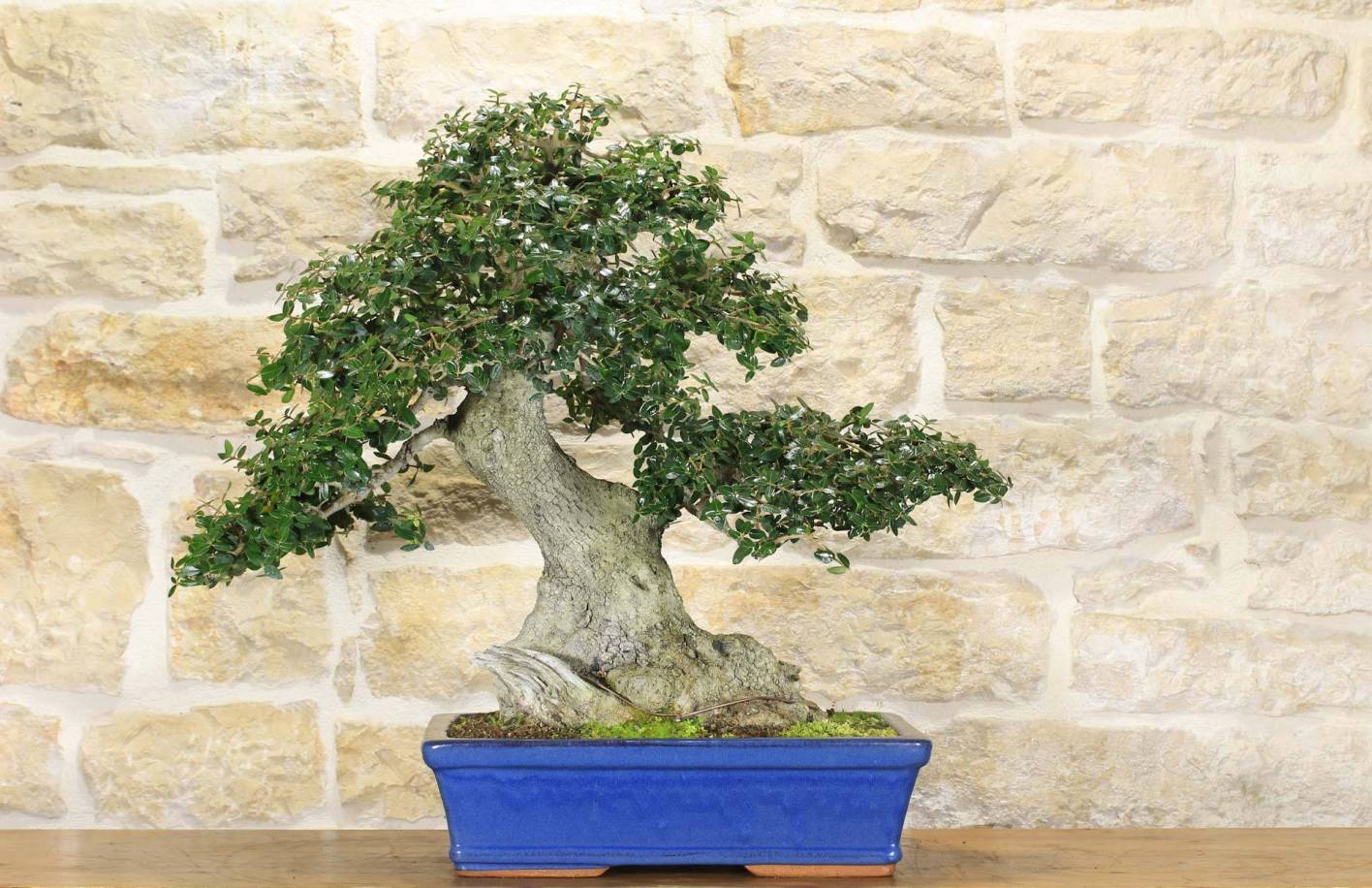
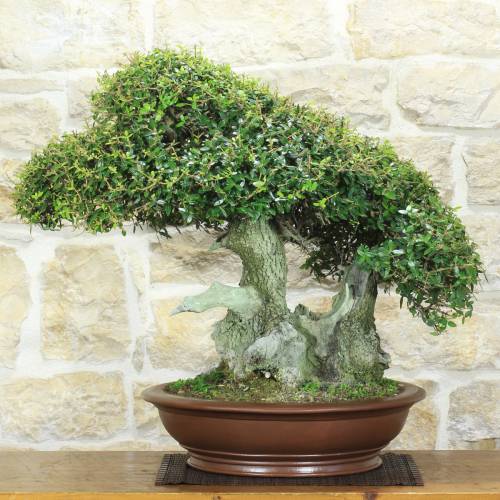
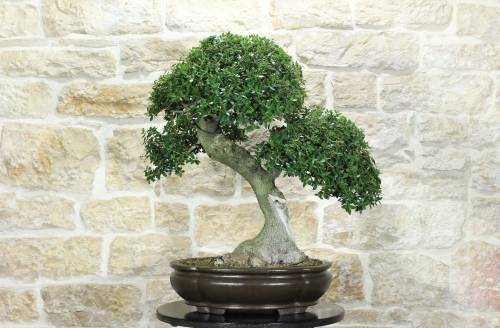
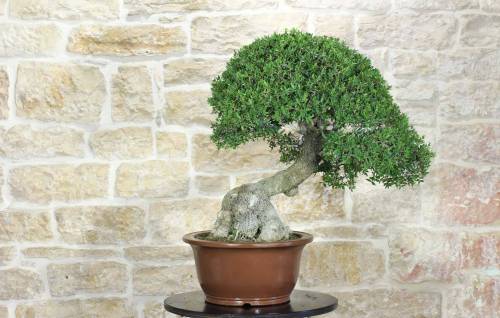
Phillyrea (or mock privet) is an evergreen shrub typical of the Mediterranean scrub, belonging to the Oleaceae family, the same as the Olive. Often mistaken by beginners for the wild olive because of its similar leaves, Phillyrea is in fact a first-rate species for bonsai. It has two features that make it unique: an ability to branch densely, forming compact pads far more quickly than the olive, and extremely hard wood that allows the creation of natural deadwood (jin and shari) that lasts over time.
Found throughout the Mediterranean basin. Two species are mainly used in bonsai:
Phillyrea Angustifolia: narrow, long and very elegant leaves; it is the most sought after for its small foliage.
Phillyrea Latifolia: broader, oval leaves, which nevertheless reduce well under cultivation.
Both are extremely hardy plants, used to living on dry, rocky ground, lashed by sea winds.
Phillyrea is a sun-loving plant: it wants full sun.
Direct sunlight is essential to keep internodes short and leaves small and leathery. Kept in the shade, the growth stretches out, loses its compactness and becomes vulnerable to pests. It fears neither heat nor strong wind.
Although in the wild it is a champion of drought resistance, in a pot it needs careful management.
Water when the soil mix is dry. It dislikes waterlogging, which can cause root rot, but it must not be left to bake dry in summer either, or it will lose part of the inner canopy. Regular watering without excess is the key.
It is a hardy plant and not fussy.
It tolerates tap water perfectly well, even if hard or slightly brackish. No special water is required.
Drainage must be excellent, to replicate its rocky habitat.
Carried out in spring (March-April), when the buds begin to move, or in autumn (September).
Mature specimens are repotted every 3-4 years. Phillyrea has strong roots and tolerates root-ball reduction well but, as with the olive, avoid washing the roots completely bare unless strictly necessary.
Feed from spring to autumn with slow-release organic fertilizer.
As a vigorously growing plant, it needs constant nourishment. Suspend only during the hottest months (July-August) and in winter.
In spring it produces small, very fragrant white flowers (a honey scent) in the leaf axils.
In autumn small black berries (drupes) ripen, like miniature olives. They are decorative but consume energy: on plants still in training it is better to remove them.
Phillyrea wood is exceptionally hard and compact. Major cuts are made at the end of winter.
Because of this hardness, use very sharp tools. Stubs or broken branches can be stripped of bark and turned into jin (deadwood), which on this species look very convincing and last well.
The plant tends to produce long, straight shoots (suckers) which must be removed or drastically shortened during the growing season, to keep the shape of the canopy and redistribute energy.
To obtain the famous compact foliage pads, pinching is essential.
Trim the new green shoots when they have produced 4-6 leaves, cutting back to 2 leaves. Phillyrea responds very well, pushing back buds even on old wood.
Be careful: branches lignify and become stiff very quickly.
Wiring should be done on young, green branches. Bending an old Phillyrea branch with wire alone is almost impossible and risks breakage: better to use guy wires to lower the main branches gradually over time.
It is a robust plant, but it has two recurring enemies:
In central and southern Italy it lives outdoors all year round.
In the north it is hardy, but in the case of intense and prolonged frosts (below -5°C) it is best to protect the root system by mulching the pot or moving the tree into a cold greenhouse, especially if the bonsai is small.
How do I tell it apart from the Olive or the wild olive?
Look at the leaves: in Olive/wild olive they are arranged alternately (or sub-opposite) along the branch and the underside is often silvery/grey. In Phillyrea the leaves are strictly opposite (in pairs, facing each other) and the underside is light green, not silvery.
Can I collect it in the wild (yamadori)?
Phillyrea has a very high survival rate after collection compared with other species, because it produces roots easily even from old wood. Even so, always respect local laws on collecting wild plants.
Why doesn't the wire hold the bend?
Because Phillyrea wood is elastic when young but extremely hard when old. If you try to bend an already lignified branch, it will spring back or snap. You have to work while the branch is still herbaceous, or use guy wires.
There are 3 products.