
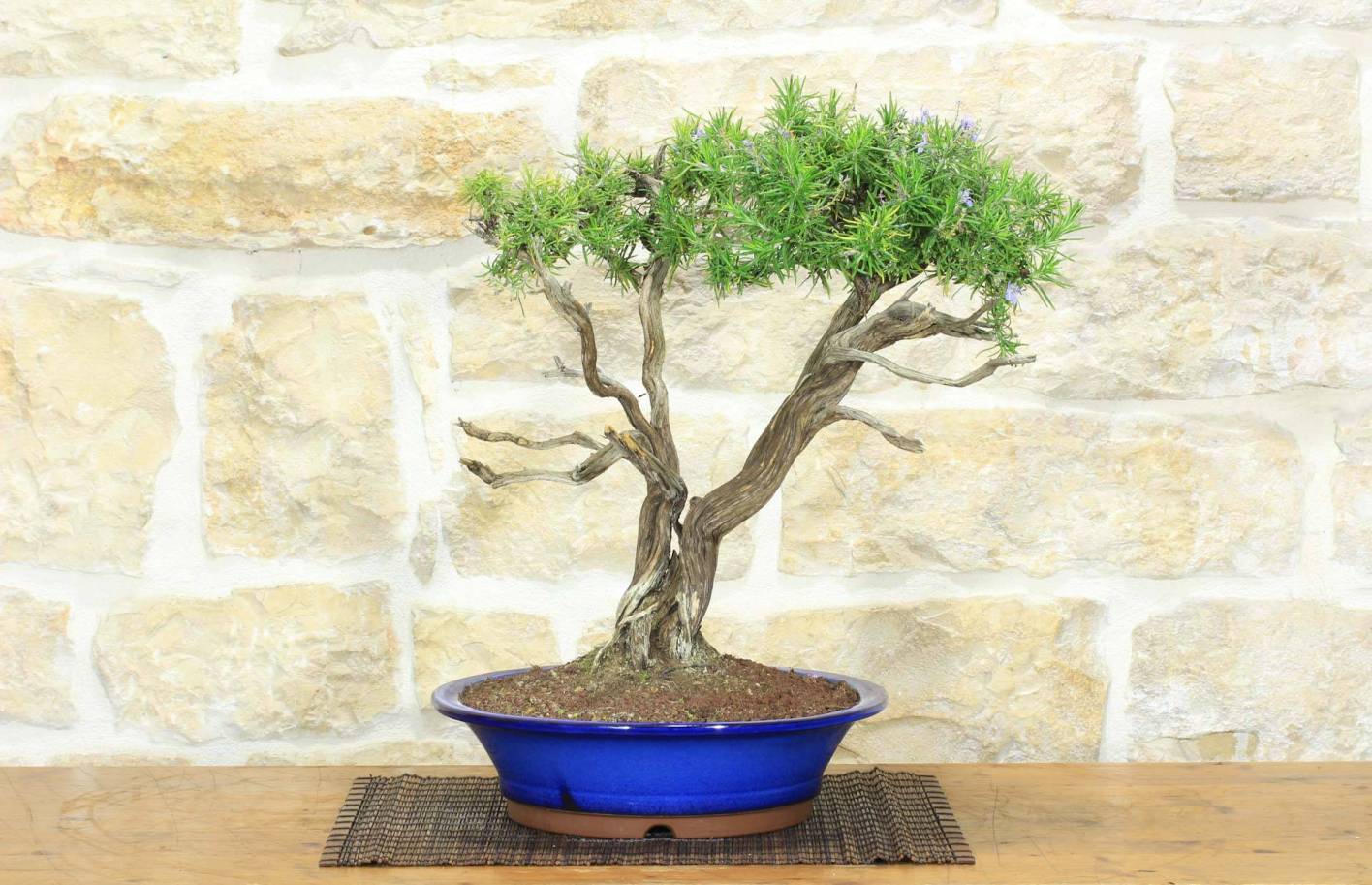
Rosemary Bonsai: Complete Guide, Deadwood and Care

ROSEMARY BONSAI

The Rosemary Bonsai: a Living, Scented Sculpture

Rosemary (Rosmarinus officinalis, now reclassified as Salvia rosmarinus) is far more than a kitchen herb. In the bonsai world it is highly valued for its "old" character even at a young age: the bark flakes off in strips, the deadwood (jin and shari) preserves extremely well and turns silvery white, and the dense crown produces enchanting blue-violet flowers. It is a plant that speaks of sun, sea and rock. If you are looking for a bonsai that also appeals to the sense of smell, Rosemary is the obvious choice.

Origin & species

Native to the Mediterranean basin, it grows wild on limestone cliffs and coastal areas. It is an evergreen shrub. For bonsai, varieties such as Rosmarinus officinalis 'Prostratus' are often used, which tends to grow horizontally or in a cascading habit, making it perfect for prostrate or root-over-rock styles.

Exposure and microclimate

Rosemary is a sun-loving plant: it wants full sun.
Direct light is essential to keep the internodes short and the foliage compact. If kept in the shade, the branches stretch out (they "run") and the plant weakens rapidly. It likes heat and moving air; stagnant air encourages fungal diseases (such as powdery mildew).

Watering

Although in nature it lives in arid places, in a pot water management is delicate.
Water generously when the soil mix is dry.
Caution: Rosemary has fine, delicate roots that rot immediately if water stagnates, but they dry out just as quickly if left without water for too long in summer. Balance is the key: free-draining soil and regular water.

Water quality

It is a hardy plant that tolerates tap water. However, a prolonged excess of limescale can block the uptake of micro-elements. If possible, use settled or rainwater.

Substrate

Drainage must be perfect. Root rot is enemy number one.

  • Recommended mix: 60% pumice (essential), 20% akadama and 20% general-purpose soil mix.
  • A predominance of inert, porous material such as pumice guarantees oxygen at the roots, mimicking the rocky ground of its origin.

Repotting

Carried out in late spring (May), preferably after flowering.
Repot every 2-3 years. Pay close attention to the roots during repotting: never reduce the root ball drastically (20-30% at most), because Rosemary struggles to recover from heavy root trauma. Use unglazed pots to encourage transpiration.

Fertilising

Feed with solid slow-release organic fertilizer in spring and autumn.
Do not overdo nitrogen, or growth becomes untidy and too soft. In autumn, potassium helps harden the wood and prepare for flowering.

Flowering and fruiting

It often flowers twice a year: the main flowering is in early spring (March-April), but it can repeat in autumn. The flowers are small and two-lipped, blue, violet or white. They are very attractive to bees.
After flowering, remove the spent flowers to keep things tidy and to avoid seed set, which tires the plant.

Structural pruning

Major cuts are made in late summer or early autumn.
Rosemary wood is very hard. Use the oblique branch cutter for clean cuts.
Important note: Rosemary rarely back-buds on old, bare wood. Always leave a tuft of foliage at the tip of the branch you cut, otherwise that branch will dry out completely.

Maintenance pruning

During the growing season, shorten the branches that break the silhouette. Always cut leaving some green behind. This keeps the crown dense.

Pinching

To thicken the foliage pads, pinch the soft apical shoots with your fingers during spring. This stops extension growth and encourages the production of side shoots.

Wiring & bending

Rosemary wood is extremely brittle and snappy.
Wiring can only be done on very young, green branches. If you try to bend a lignified branch, it will snap clean off without warning. Proceed with the utmost care.

Diseases and pests

  • Rosemary beetle: a small metallic beetle that eats the leaves.
  • Red spider mite: common in summer if the air is dry.
  • Powdery mildew: a white film on the leaves caused by poor ventilation.
  • Root rot: the silent killer if you water too much.

Winter & protection

It is a tough plant, but in a pot the roots suffer from hard frost.
In the south it lives outdoors without problems. In the north, if temperatures stay below -3/-4°C, it should be protected in a cold greenhouse or covered with fleece, in a sunny position. Cold winter damp is more dangerous than dry cold.

Annual calendar

  • January-February: rest, cleaning the deadwood.
  • March-April: flowering, light feeding.
  • May: repotting (after flowering), green pruning.
  • June-August: regular water, full sun, pinching.
  • September-October: autumn feeding (PK), possible second flowering.
  • November-December: frost protection.

Useful products for this bonsai


Frequently asked questions about Rosemary

Why did a branch suddenly dry out after pruning?
You probably cut back too far, removing all the green. Rosemary does not have dormant buds on old wood like broadleaves do. If you take all the leaves off a branch, that branch dies. Always leave a green sap-puller at the tip.

How do you make white deadwood?
Rosemary has a live vein (reddish) that contrasts with the dead wood. When a branch dies or breaks, strip the bark, clean it thoroughly and apply jin liquid. It will turn bone white and be protected from fungi.

Can I keep it in the kitchen?
No. The Rosemary bonsai is not a houseplant. It needs direct sun, wind and a day-night temperature swing. In a kitchen, with steam and little light, it would die within a few weeks.

404 Error

This page is no longer among our branches.

The page you are looking for may have been moved, removed, or is no longer available. But your next bonsai, accessory, or gardening item is still here waiting for you.

Explore the main categories or use the search below.
404

No problem: we will help you quickly find bonsai, pots, accessories, and useful content.

A reference point for bonsai and gardening lovers

Quickly find bonsai, gardening items, pots, accessories, and useful content to better take care of your plants.

Explore the catalog