
€390.00

Home

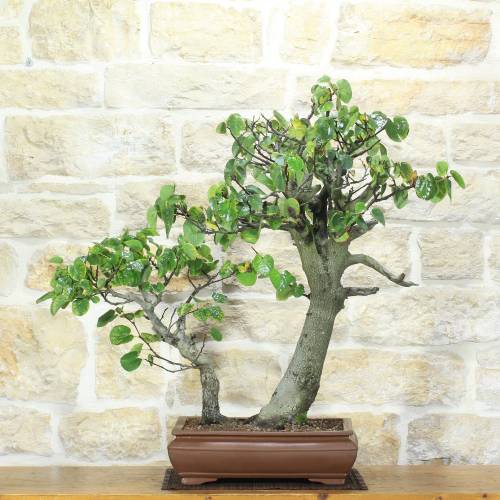
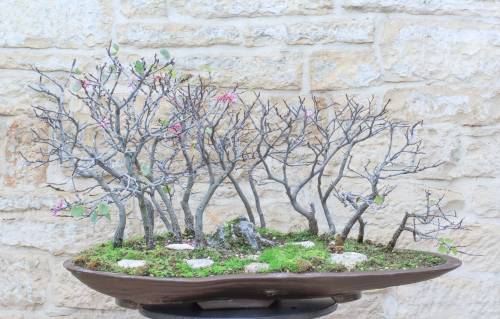
The Judas Tree (Cercis siliquastrum) is one of those species that leaves you speechless. Picture a dark, weathered trunk from which, in spring, before the leaves even appear, clusters of pink-violet flowers burst straight out of the old bark. This phenomenon, known as cauliflory, makes Cercis unique in the bonsai world. It is a hardy tree, typical of our Mediterranean, with perfect heart-shaped leaves, but it does need some care to manage its vigour and leaf size.
It belongs to the Fabaceae family (legumes) and comes from southern Europe and Asia Minor. In the wild it often grows on stony, limestone ground, developing very attractive twisted trunks. The species Siliquastrum is the one most used for bonsai: robust and long-lived, able to cope even with urban pollution.
Cercis wants sun. Don't be afraid to expose it:
Full sun is the rule. Only with plenty of light will you manage to reduce its leaves (which naturally tend to grow as large as the palm of your hand) and encourage abundant flowering.
It tolerates summer heat well, but as always, in a small pot, a little shade during the scorching hours of August helps keep the foliage fresher.
Being used to dry ground, it fears excess water far more than drought. Waterlogging is lethal and causes root rot very quickly.
Water only when the substrate is thoroughly dry. In winter, cut right back: the soil should stay barely damp.
It is an undemanding plant that likes limestone soils. Tap water is perfectly fine and, in fact, the calcium content is welcome. There is no need to fuss with reverse osmosis or acidified water for this species.
Drainage, drainage, drainage. The mix must be coarse so that air and water pass through quickly.
Carried out in spring, as soon as the buds start to swell (March-April).
Mind the taproot: young plants develop a deep central root (taproot) which should be reduced gradually over the first few years to encourage lateral roots. On old plants, go easy with root pruning: Cercis does not like drastic root disturbance. Use pots that are slightly deeper than usual.
Like all legumes, Cercis is able to fix atmospheric nitrogen.
Don't overdo nitrogen-rich fertilizer, or you will end up with giant leaves and very long internodes. Prefer organic fertilizers rich in phosphorus (P) and potassium (K), especially in autumn, to encourage the following year's flowering and the ripening of the wood.
Flowering is the main show and occurs on older branches or on the trunk. After the flowers it produces long, flat pods (siliquae) that hang from the branches. On a bonsai these pods take a lot of energy: enjoy the flowers, but remove the fruit as soon as it forms so as not to weaken the tree.
Done in winter. Since the flowers come from old wood, drastic winter pruning will also remove the following spring's flowers. If structure is the goal, sacrifice the flowering; if you want the flowers, limit yourself to a light clean-up and prune more decisively AFTER flowering.
Trim back new shoots during the growing season, leaving two leaves. If the leaves become too large, in June you can carry out defoliation (cutting the leaves and leaving the petiole), but only on plants in perfect health. This will trigger a new flush of smaller leaves.
Cercis branches lignify quickly and become stiff and somewhat brittle where they join the trunk.
Apply the wire to young branches in summer, taking care not to tighten too much because the bark marks easily. For thicker branches, guy wires are a better option.
It is a tough plant, but it has two specific enemies:
It takes cold well, down to a few degrees below zero. However, since it is grown in a pot, if temperatures drop below -5°C for long periods it is wise to protect the root system with fleece or mulch, or move it into a cold greenhouse. Watch out for late frosts, which can burn the flowers.
Why doesn't my bonsai flower on the trunk?
Flowering on the trunk (cauliflory) takes time. The plant must be mature (often over 10-15 years old) and have old bark. It also needs a great deal of sun and a potassium-rich feed in autumn.
My leaves are huge, what can I do?
That is the natural tendency of Cercis. Avoid nitrogen in spring, give as little water as possible (without killing it!) and keep it in full sun. If the plant is strong, defoliate it completely in June.
Can I create deadwood (jin) on Cercis?
Yes, the wood is fairly hard and durable. However, Cercis tends to compartmentalise wounds by withdrawing the sap flow, so be careful when working deadwood close to live veins and always leave a safety margin.
There are 3 products.