
Prunus Mume Bonsai: Winter Flowering & Care Guide

PRUNUS MUME BONSAI

The Prunus Mume Bonsai: Herald of Spring

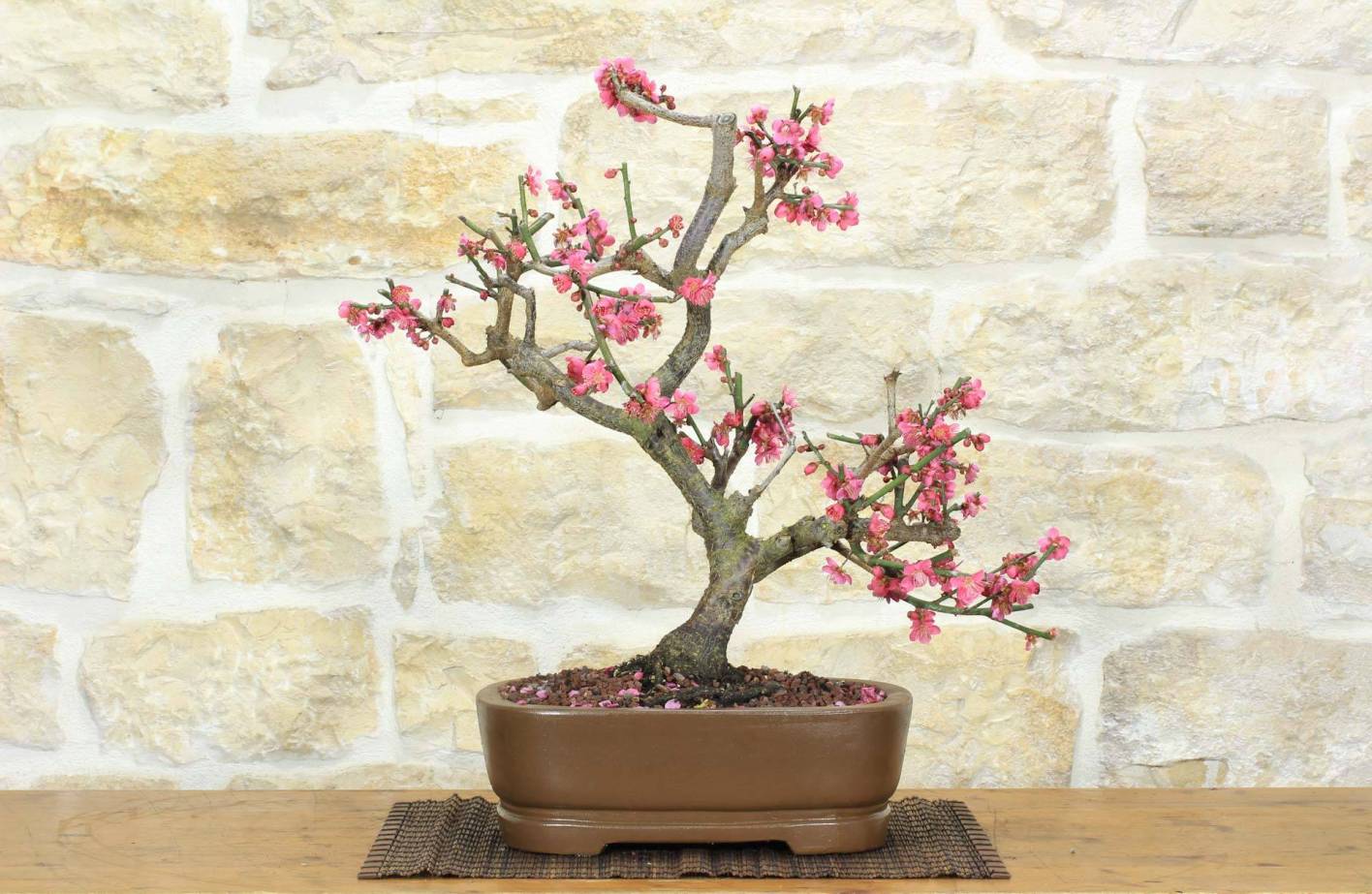
Prunus Mume, known as the Japanese Apricot (or, mistakenly, "Plum"), is a bonsai loaded with symbolism. It is the tree that announces the end of winter: its scented flowers open on bare, dark branches, often under the snow, in January or February. It is prized for its rough, dark bark, for branches that grow at sharp angles with natural zig-zags, and for the heady scent of flowers ranging from white to deep pink and red. It is a tree for enthusiasts who look for "Wabi-Sabi" beauty, imperfect and austere.

Origin & species

Native to China but a cultural icon of Japan, it belongs to the Rosaceae family. There are hundreds of varieties (cultivars) selected for flower colour and shape (single or double). The variety "Yatsufusa" is much sought after for bonsai because it has short internodes and flowers abundantly. Choice varieties are often grafted onto more robust wild rootstocks.

Position and microclimate

Prunus Mume needs full sun.
Sun exposure is essential for two reasons: ripening the flower buds for the following year and preventing the fungal diseases to which it is prone. It likes a well-ventilated spot.
In summer, in very hot areas, light shading during the central hours helps keep the leaves green for longer, but do not deprive it of light.

Watering

This is a tree that likes water, especially during flowering and spring growth.
Water generously when the surface of the soil mix starts to dry.
Caution: when the buds are swelling in winter, never let it run short of water, or they will abort and drop before opening. However, avoid wetting the open flowers directly, so as not to spoil them or cause them to rot.

Water quality

It prefers neutral or slightly acidic water. Water that is too hard can cause chlorosis in the long run. If you use hard tap water, alternate with rainwater or use chelated iron products periodically.

Substrate

Drainage must be perfect; Prunus roots suffer badly from waterlogging and suffocation.

  • Recommended mix: 60% Akadama (essential for developing fine roots), 30% pumice and 10% general-purpose soil or humus.
  • The use of pure Akadama, or a high percentage of it, is strongly recommended for this species.

Repotting

The timing of repotting is very specific: it is done immediately after flowering (February-March), before the leaves open.
Repot every 1-2 years for young trees, every 2-3 for old ones.
Prunus roots are fleshy and fragile: handle them with care. Watch out for root rot (you often find a portion of black roots that must be removed, leaving the white, healthy ones).

Fertilising

To support flowers and growth, the tree must be fed well.
Start feeding generously with solid organic fertilizer after flowering (April-May) to give the tree energy. Stop in summer. Resume in autumn (September-October) with a fertilizer rich in phosphorus and potassium to encourage the formation of the winter flower buds.

Flowering and fruiting

It flowers in winter/early spring on bare branches. The flowers are the main reason it is grown.
If the flowers are pollinated, it produces small yellow, sour fruits (apricots). On a bonsai it is advisable to remove the small fruits as soon as they form: ripening them uses up enormous energy that the tree would take away from its foliage and from the following year's flowering.

Structural pruning

Carried out in autumn or early winter.
Remove dead branches, crossing ones and vertical suckers. Be careful not to cut the short twigs covered in rounded buds: those are the flowers getting ready!

Maintenance pruning (post-flowering)

This is the most important pruning of the year. It is done as soon as the flowers fade.
Prune the branches that have flowered, leaving only 1 or 2 leaf buds (the small, pointed ones at the base). From these buds will come the new branches that will bear next year's flowers. If you skip this pruning, the branches will lengthen and flowering will move further and further away from the trunk.

Pinching

During spring growth, if the new shoots extend too much (beyond 10-15 cm), pinch them back to 2-3 leaves to keep the shape compact and encourage inner ramification.

Wiring & bending

Prunus branches are stiff, angular and brittle: they snap easily if forced.
Wiring is done on young branches in spring. For old branches, always use guy wires. The look of a Prunus should be slightly "wild" and angular, not soft and sinuous like a pine.

Diseases and pests

  • Aphids: they attack the new green shoots in spring.
  • Peach leaf curl/fungus: leaves that curl up and turn reddish. Treat with copper-based or specific fungicides in winter and spring.
  • Scale insect: often on old branches.
  • Cossus cossus (goat moth): watch for holes in the trunk, the larvae tunnel through the wood.

Winter & protection

It is very cold hardy (down to -10°C).
However, since it flowers in winter, hard frosts when the buds are ready or open will scorch the flowers. To enjoy the flowering, when you see the buds taking colour, move the tree into a cold greenhouse or under a bright shelter.

Yearly calendar

  • January-February: flowering (a show!), protect the flowers from frost.
  • March: repotting (after flowering), hard pruning of the branches that have flowered.
  • April-May: heavy feeding, vegetative growth, aphid prevention.
  • June-July: pinching of green shoots, flower bud formation (invisible, but it happens now).
  • August: rest, regular watering.
  • September-October: autumn feeding (PK), leaf fall.
  • November-December: rest, cleaning of the branches.

Useful products for this bonsai


Frequently asked questions about Prunus Mume

Why doesn't it flower?
The main causes are: incorrect pruning (you cut off the branches with the buds in autumn/winter), lack of sun in summer (when the dormant buds are formed), or an excess of nitrogen that has pushed only leaves.

Can I keep it indoors while it is in flower?
Only for 2-3 days, to show it to guests or enjoy the scent. If you keep it in the warmth for too long, the flowers will drop at once and the tree will weaken, believing spring has arrived and budding out too early.

What are the white wood areas on the trunk?
Old Prunus Mume often show hollow or debarked parts of the trunk (called "Shari" or "Sabamiki"). It is a much appreciated aesthetic feature that suggests the great age of the tree. These areas should be treated with Jin liquid so they do not rot.

404 Error

This page is no longer among our branches.

The page you are looking for may have been moved, removed, or is no longer available. But your next bonsai, accessory, or gardening item is still here waiting for you.

Explore the main categories or use the search below.
404

No problem: we will help you quickly find bonsai, pots, accessories, and useful content.

A reference point for bonsai and gardening lovers

Quickly find bonsai, gardening items, pots, accessories, and useful content to better take care of your plants.

Explore the catalog