
€390.00

Home

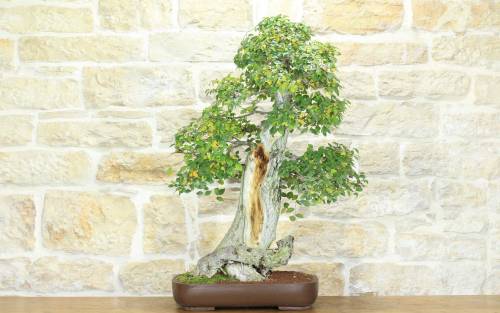
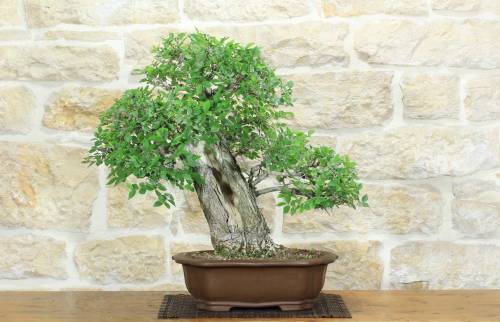
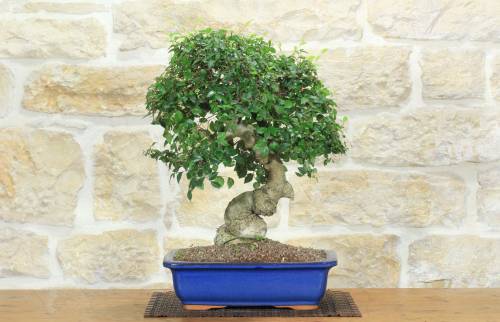
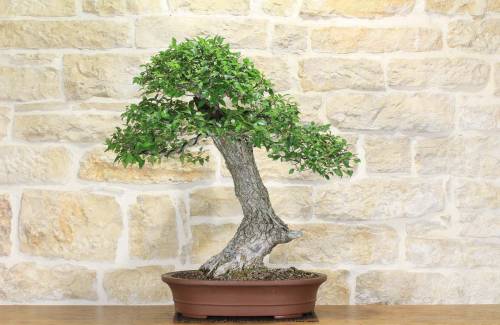
The Field Elm (Ulmus minor or campestris) is perhaps the tree that best represents the rural Italian landscape of the past. Unlike its Chinese "cousin" (Ulmus parvifolia), our native elm is decidedly deciduous, giving us a clear change of season. It is loved by bonsai growers for its bark, which in some specimens becomes rough and corky (the "suberosa" variety), for the fine ramification that can be built up over the years, and for its incredible toughness. It is a "forgiving" tree, ideal for learning, yet capable of becoming a masterpiece.
Native to Europe, North Africa and south-western Asia. It is an indigenous plant that grows wild in our woods and plains. Unfortunately, in nature the population has been decimated by Dutch elm disease (a fungal disease), but grown in a pot as a bonsai it is easier to protect and preserve. It is a vigorous species with strong apical dominance.
It loves full sun.
Direct sun exposure is essential to reduce leaf size (which otherwise tends to become large) and to keep internodes short.
It stands up well to wind. In midsummer, in hotter areas, it appreciates light afternoon shade just to avoid scorching on the leaf tips, but it is far more heat-tolerant than the Chinese elm.
The Field Elm drinks willingly.
Water generously when the soil starts to dry on the surface. In summer never let it run short of water: if it suffers water stress, it sacrifices its leaves, turning them yellow and dropping them early (a defence mechanism). In winter, with the tree bare, reduce drastically, keeping the soil mix barely damp.
It is a hardy plant, used to our soils.
It easily tolerates tap water, even hard water. It does not need any particular or acidified water.
It adapts to many soils, but for optimal bonsai cultivation drainage is needed.
Carried out every 2-3 years (every year for young, fast-growing plants).
When: At the end of winter, as soon as the buds swell but before the leaves open (February-March).
The elm has very strong roots and tends to fill the pot quickly. Do not be afraid to prune the roots decisively during repotting; it reacts very well, producing new rootlets everywhere.
Fertilize from spring to autumn.
In spring, to push growth, use a balanced fertilizer. If the tree is already formed and you want to control growth, use less nitrogen-rich slow-release fertilizers and start feeding only when the leaves have hardened off (May). Autumn fertilizing is essential to prepare the winter buds.
It flowers at the end of winter, often before the leaves appear, with tiny flowers.
It then produces samaras (small winged green seeds) in clusters. They are pretty to look at, but they use up energy: if the bonsai is still being built, remove them so as not to slow down vegetative growth.
Carried out in winter, with the tree bare, when it is easy to see the branch structure ("the nakedness of the tree").
Remove branches growing straight upwards, those that cross, or those emerging from the armpits of the main branches. Use cut paste on large cuts, since the elm heals by forming a "callus" that can become unsightly if not managed.
During the growing season the elm grows quickly.
Let the new shoots extend to 4-6 leaves, then cut them back to 2 leaves. This continuous work serves to create and maintain dense foliage pads.
On shoots that have just opened in spring, you can work with your fingers (pinching), removing the central tip to stop extension immediately and encourage immediate ramification further back. Useful on already refined trees.
The branches of the Field Elm are flexible when young, but become stiff and snap cleanly once lignified.
Wiring is best done in autumn or early spring on 1-2 year old branches. Check the wire often: the bark grows fast and the wire bites in within a few weeks during the growing season.
It is hardy and frost-resistant.
It can stay outdoors all year round. Only in the case of exceptional and prolonged frosts should you protect the pot, to prevent the root ball from becoming a single block of ice, which could damage the finest roots.
What is the difference with the Chinese Elm (Zelkova)?
The Field Elm (Ulmus minor) has duller leaves, often slightly hairy or rough, and bark that becomes dark and furrowed (sometimes corky). It drops its leaves in winter. The Chinese Elm (Ulmus parvifolia) has glossy, smooth leaves, bark that flakes off in patches (mottled) and tends to keep its leaves in mild weather.
I found the leaves riddled with holes, what is happening?
It is almost certainly the elm leaf beetle. The larvae of this insect eat the green part of the leaf, leaving only the veins. Treat with an insecticide as soon as you see the first holes, otherwise they can strip the tree of its leaves in a few days.
What is the "corky" elm variety?
Some field elms naturally develop corky "wings" on the branches and trunk to protect themselves from heat and cold. In bonsai this feature is highly prized because it gives the tree an ancient, dramatic look even at a young age.
There are 8 products.