
€390.00

Home

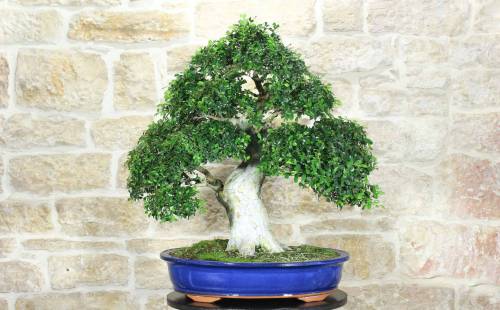
Zelkova Parvifolia is often every bonsai grower's first love. It is a remarkable tree: tiny, serrated, glossy leaves, a bark that flakes away revealing patches of different colour, and an almost touching tolerance of mistakes. Although it is usually sold as "Zelkova", botanically it is nearly always an Ulmus Parvifolia (Chinese Elm). It is the ideal tree for learning pruning and fine ramification, able to give aesthetic satisfaction worthy of the great masters even to beginners.
Native to China, Korea and Japan, this species belongs to the Ulmaceae family. It is a semi-deciduous tree: in our cold climates it drops its leaves in winter, but if kept in a greenhouse or in mild climates (southern Italy) it can keep them all year round. It is famous for its ramification, which becomes extremely dense, like a spider's web, when well managed.
This is an outdoor plant.
Spring/Summer: Full sun. Sun reduces leaf size and shortens the internodes. Only in July and August, if you live in a scorching area, some afternoon shade will stop the leaf margins from burning.
Winter: It takes the cold well. If you want to enjoy the bare silhouette and give it a proper rest, leave it outside (protecting the roots in case of hard frost). If you bring it indoors it will survive, but it will weaken over time and will not drop its leaves.
The elm drinks regularly. The soil should dry slightly at the surface before watering again. Never leave it dry for days: if it suffers from thirst it drops all its leaves at once (though it often flushes out new growth after a week of care).
It tolerates tap water without problems. It is a rustic and adaptable plant.
Standard soil mix for broadleaves, free-draining but nutritious.
It grows fast! Young trees are repotted every year or two, older ones every 3.
When: Late winter (February-March), as soon as the buds swell.
It tolerates drastic root pruning. Untangle the roots well and try to build a flat root mass so you can use low, elegant pots.
Fertilize from spring to autumn.
In spring use a fertilizer richer in nitrogen to get the vegetation going. In autumn switch to phosphorus and potassium to prepare it for winter. If the tree is already formed and you want to keep the leaves small, fertilize less in spring.
It flowers in autumn with tiny flowers, followed by greenish samaras (winged seeds). They are not particularly ornamental and often go unnoticed.
This is the heart of growing elms.
Let the new shoots grow to 4-5 pairs of leaves, then cut back leaving only 1 or 2. Do this throughout the growing season. It will build dense, compact foliage pads.
In winter, with no leaves, you can see the "fishbone" structure of the branches. Remove crossing branches, those growing inwards or awkwardly up or down. Use concave cutters for the larger cuts.
The branches are flexible and wire well in summer or winter. Be careful: the bark marks easily and the branches thicken quickly. Often directional pruning ("clip and grow") is enough to shape it, with no need for wire.
As mentioned, it withstands moderate frost. In the north, protect the pot with mulch. In the south it is perfectly happy outdoors all year.
What is the difference between Zelkova Parvifolia, Chinese Elm and Ulmus Chinensis?
Here is where the confusion lies! Commercially they are all called "Zelkova", but:
- Ulmus Parvifolia (Chinese Elm): This is what you buy 99% of the time. It has small leaves, bark that flakes in plates and flowers in autumn.
- Zelkova Serrata (Japanese Elm): It has larger, longer and pointed ("serrate") leaves, smooth grey bark and flowers in spring. It is rarer as a commercial bonsai.
- "Ulmus Chinensis" is often an improper synonym used for Parvifolia.
In short: if it has tiny leaves and bark that peels, it is a Chinese Elm (Ulmus Parvifolia), even if the label says Zelkova!
Why does it lose its leaves in winter if I was told it is evergreen?
The Chinese Elm is "semi-deciduous". Its behaviour depends on the climate. In the cold it behaves like a northern tree and drops its leaves to protect itself. In the warmth (or indoors) it behaves like a tropical plant and keeps them. For the plant's health, letting it drop its leaves and rest in the cold is the best option.
Can I keep it in the office?
Yes, if there is plenty of light (in front of a window), but remember it is an outdoor tree. In an office it will survive, but it will grow weak and with long internodes. If you can, put it outside at weekends or during the summer.
There is 1 product.