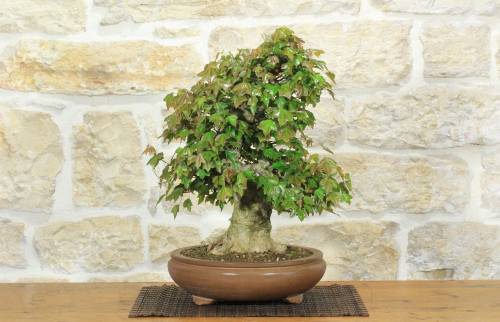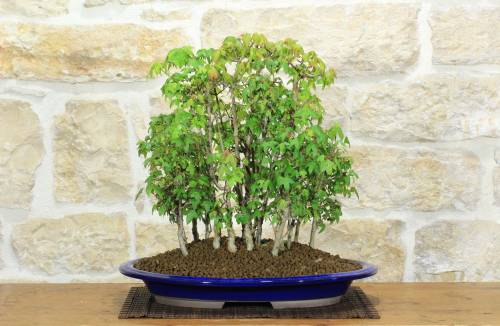

€390.00

Home

The Trident Maple (Acer buergerianum), known in Japan as "Kaede", is one of the most iconic species in the bonsai world. If you are looking for a tree that gives quick satisfaction and responds fast to your work, this is the one. Famous for its three-lobed leaves that light up orange and red in autumn, and for its remarkable ability to develop a powerful base (nebari) with radial roots, it is a robust and vigorous species, perfect for learning broadleaf techniques.
Native to eastern China and Japan, the Trident Maple is a very vigorous deciduous tree. Unlike its "cousin" the Japanese Maple, the Trident has thicker, more leathery leaves and a bark that, on mature specimens, flakes off in plates revealing beautiful shades. It is a very "plastic" plant, suited to almost every bonsai style, especially root-over-rock precisely because of the strength of its roots.
The Trident Maple loves sun, which is essential to reduce leaf size and obtain short internodes.
In spring and autumn: Place it in full sun.
In summer: Beware of the fierce July and August sun. Although it is tougher than the Japanese Maple, its leaves can scorch if the air is too dry. In southern Italy or in very hot areas, partial shading (or a shade net) during the hottest hours is strongly recommended to keep the foliage healthy until autumn.
It is a big drinker! With a very active root system, it uses a lot of water while in growth.
Water generously when the soil mix starts to dry on the surface. In summer it may need watering twice a day (morning and evening). If the plant runs short of water it will tell you straight away by wilting its leaves: act immediately, but avoid keeping it constantly soaked so the roots do not rot.
It is not as demanding as azaleas, but water that is too hard can, over time, raise the soil pH and cause iron chlorosis (leaves fading to yellow with green veins). Use settled or rainwater if you can, otherwise tap water is fine as long as you keep an eye on the health of the foliage.
Given the vigour of the roots, you need a soil mix that allows excellent air circulation while still holding the necessary moisture:
Here you have to work hard. The Trident Maple fills the pot with roots at an impressive speed.
When: Late winter, as soon as the buds swell (February-March).
Frequency: Young specimens should be repotted every year, or every two years at most. Mature specimens every 2-3 years.
During repotting you can cut the roots decisively, removing the thick ones that run downwards in order to encourage fine horizontal feeder roots, essential for a good nebari.
To support vigorous growth, feed with slow-release organic products.
Start one month after bud break (so the internodes do not stretch too much right away) and continue until June. Stop in high summer. Resume in autumn with a low-nitrogen fertilizer to harden the wood and prepare the tree for winter.
It produces small yellow-green flowers followed by winged seeds (samaras), similar to those of other maples. On a bonsai, however, flowering and fruiting take a lot of energy and are not as aesthetically relevant as on Hawthorn. It is often advisable to remove the flowers as soon as they appear, so the plant's strength goes into ramification and foliage.
Large cuts are made in winter when the tree is bare. The maple tends to close wounds well, but on big cuts a very obvious "callus" often forms. To avoid it, use a concave or knob cutter (which creates a hollow) and cover immediately with cut paste, preferably the putty type that seals tightly.
During the season, trim back the new shoots leaving 2 pairs of leaves.
A key technique for the Trident is defoliation (total or partial), to be done in June on healthy plants. By cutting off the leaves (leaving the petiole) you force the tree to produce new ones: these will be smaller, will have better autumn colours and you will increase fine ramification.
As soon as the shoots open in spring you can remove the central bud if you want to stop the branch from extending, but do this only on trees that are already developed.
Young branches are flexible, but old ones become stiff and brittle. Apply the wire in late spring or in autumn after leaf fall.
Careful: bark and branches thicken quickly! Check the wire every 15-20 days, because it can bite into the bark very fast, leaving unsightly marks.
It is a strong plant, but it is prone to:
A common physiological problem is dry leaf tips (necrosis): almost always caused by water stress (too much or too little) or an excess of salts (fertilizer/hard water).
It is a hardy species, but the roots in the pot are exposed. In case of hard frosts, protect the roots by covering the pot with mulch or horticultural fleece. Watch out for late spring frosts, which can burn the delicate first shoots.
Can I defoliate my maple every year?
Yes, but only if the tree is in perfect health and vigorous. If you carried out a drastic repotting the previous year, or if the plant looks weak, skip defoliation for a year and let it rest.
Why have the leaves become huge?
Usually for three reasons: too much water, too much nitrogen fertilizer, or a pot that is too large (which drives the roots). To reduce leaf size: more sun, less water and defoliation in June.
How do I get those thick surface roots (nebari)?
The Trident is the master of nebari. The secret is to repot often when the tree is young, spreading the roots radially and pruning those growing downwards. You can also use the "tile" technique under the trunk to force the roots to spread out horizontally.
The wire has marked the bark, will the mark disappear?
The Trident Maple heals very well, but deep wire marks stay visible for years. If the mark is light it will vanish with growth and bark exfoliation; if it is deep it will become an aesthetic flaw. Better to remove the wire a little early than a little late.
There are 2 products.