
€390.00

Home

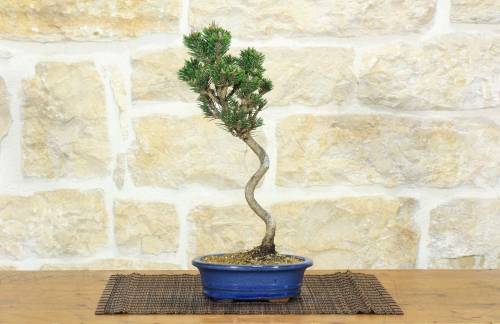
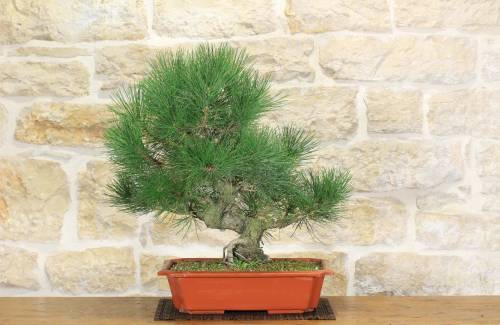
The Japanese Black Pine (Pinus thunbergii), called "Kuromatsu" in Japan, is considered the king of classic bonsai. It stands for masculine strength, with its dark, rugged bark that looks like armour and its strong, sharp needles. It is a tree that commands respect and demands dedication: unlike broadleaves, the pine does not easily forgive mistakes and requires specific pruning techniques (on the "candles") to keep the needles short. Once you understand its physiology, however, it is one of the most rewarding and long-lived species of all.
Native to the coastal areas of Japan and Korea, it is a tree used to harsh conditions: strong wind, sandy soils and salty air. This origin explains its incredible resistance and its absolute need for drainage. There are prized varieties such as "Corticosa" (corky bark) or "Yatsufusa" (very dense needles and buds), much sought after by collectors.
The Black Pine demands full sun, all day, all year round.
Direct light is the only way to activate the inner buds and keep the needles short and sturdy. If kept in half shade, the branches stretch, the needles become weak and the lower branches die from lack of light. It does not fear wind.
The pine likes a controlled water regime.
Unlike broadleaves, it prefers the substrate to dry out well between one watering and the next. Excess water leads to long needles and, in the worst cases, to root rot.
Tip: If you want short needles, slightly reduce water during the period when the candles are extending in spring (but never let it dry out completely!).
It is not demanding. Tap water is fine. Still, make sure it is not excessively saline or calcareous, so it does not clog the porosity of the soil in the long run.
Drainage is life or death. The pine breathes through its roots.
Carried out every 3-5 years, in spring (April), when the candles start to extend.
Very important: the pine lives in symbiosis with a fungus called mycorrhiza (that white mould you find among the roots). Never wash the roots bare! Always leave part of the old root ball intact to preserve the mycorrhiza, which is essential for the health of the tree.
The Black Pine is a heavy feeder. To withstand the work done on it (candle cutting) it must be very strong.
Use solid organic fertilizer (the classic "pellets") generously in autumn and in spring.
Exception: if you want short needles, do not fertilize while the candles are extending (May-June), but start again immediately after the summer pruning.
It produces small cones. On the tree the male, pollen-bearing ones (yellow) are often found at the base of the candles. They should be removed because they weaken the branch and prevent back-budding.
Large cuts and the removal of superfluous branches (selection of the foliage pads) are done during winter dormancy (December-February).
The pine produces a lot of resin: cover the cuts with cut paste to stop the resin running everywhere and to protect the wood.
This is the key technique. In late June/early July, the candles (the new shoots) that developed in spring are cut off completely.
This shock forces the tree to produce a "second flush" of buds in summer. Having less time to grow before winter, these new needles will stay much shorter and more compact.
Done in spring (April-May). If one candle is growing too strongly compared with the others, you pinch it with your fingers and break off the tip (from one third to one half). This balances the energy of the tree, slowing down the strong branches and helping the weak ones.
In winter, the old needles (2 or 3 years old) are removed and the new ones are thinned out to let light and air inside the foliage pads. Without this operation the inner shoots die and no new buds will appear.
Pine wood is flexible and resinous, and tolerates extreme bends.
The best time for wiring is winter (after needle cleaning). Copper wire (annealed) is preferable because it holds the bend better, but aluminium is also fine to start with. The wire can stay on for a year or two, checking that it does not bite in.
It is a very hardy tree, resistant to frost.
However, since the roots in the pot are exposed, protect the pot in case of hard frost. The canopy has no problems; on the contrary, cold helps to harden the plant.
Why are my pine's needles so long?
There are three causes: too much water, too much nitrogen at the wrong moment, or (more likely) you did not carry out the candle cutting technique (Mekiri) in June. Without this technique, the pine naturally tends to produce long needles.
What is that white mould among the roots? Is it harmful?
Absolutely not! It is the mycorrhiza, a beneficial fungus that helps the pine absorb nutrients. It is a sign that the plant is doing very well. When you repot, do not throw it away but mix a little of that old soil into the new substrate.
Can I keep it indoors?
No, never. The Black Pine is strictly an outdoor tree. Indoors it would die within a few months from lack of light and lack of temperature variation.
There are 4 products.