
€390.00

Home

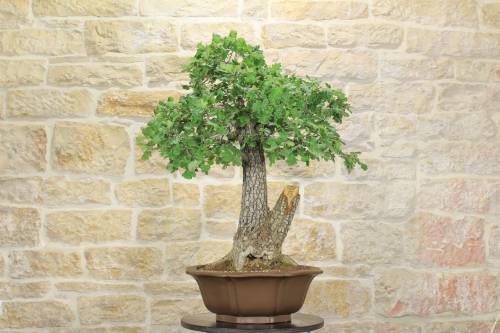
The Downy Oak (Quercus pubescens) is the species that embodies the Italian hill landscape. It is an oak "with character", sturdy and austere, valued in bonsai for its bark, which turns grey and scaly with age, and for the charm of its lobed leaves. One distinctive feature is its "tomentosity" (a fine down on the underside of the leaves) and the phenomenon of marcescence: the leaves dry out in autumn, turning bronze, but stay attached to the branches all winter long, falling only when the new buds break in spring. It is a bonsai that teaches the rhythm of the seasons.
Native to southern Europe and Asia Minor, it is the most widespread oak in Italy. The Latin name pubescens refers precisely to the down covering the young leaves and twigs. It is an extremely adaptable plant, able to live on dry, calcareous soils where other oaks would suffer.
The Downy Oak loves full sun.
Direct light is essential to reduce leaf size and keep the internodes short. Moreover, sun and air are the best antidotes against powdery mildew, to which this species is particularly prone because of the down on its leaves.
It stands up well to heat and wind. Do not keep it in shady or poorly ventilated places.
It is a plant that tolerates short dry spells well, but in a bonsai pot it needs regularity.
Water when the soil mix feels dry to the touch. Avoid keeping the soil constantly soaked: oak roots are prone to rot and suffocation. In winter, water sparingly, just enough to keep the root ball from drying out completely.
It is a very hardy plant that grows naturally on calcareous soils.
It tolerates tap water without problems. There is no need to use osmosis water or to acidify, unless the water is excessively hard or saline.
It prefers free-draining, neutral or slightly basic (calcareous) substrates.
Carry it out in late spring (April-May), when the buds swell noticeably.
Repot every 3-4 years. As with all oaks and beeches, the roots live in symbiosis with a fungus (mycorrhiza). Never bare-root the plant, and always leave some old soil around the trunk so as not to lose this vital bacterial flora.
Feed with solid organic fertilizer in spring and autumn.
In spring it supports the new growth, but do not overdo the nitrogen, or you will get oversized leaves. Autumn feeding is essential to harden the wood and prepare the buds for the following year.
It produces acorns, but they are rarely seen on bonsai grown in small pots, since they require a great deal of energy and the plant must be mature. Should any form, it is advisable to remove them so as not to weaken the tree.
Major shaping cuts are made in winter.
Downy Oak wood is hard and tough. Protecting the cuts with cut paste is a must, because oaks tend to withdraw sap and create dieback if the wound is left exposed. Dead or broken branches can be worked into jin to give an aged appearance.
During the growing season the Downy Oak produces vigorous apical shoots. Shorten them regularly to redistribute strength to the lower and inner branches, which would otherwise risk declining.
To thicken the canopy, tip the new shoots once they have produced 4-5 leaves, cutting them back to 2.
Defoliation (total or partial) in June is a very effective technique on the Downy Oak for reducing leaf size, but it should only be done on trees in perfect health and well fed.
Oak branches stiffen very early and are difficult to bend once lignified.
Wiring is done on young twigs in spring/summer. For thick branches, guy wires are the best and safest solution for changing the angle without breaking the wood.
It is a very cold-hardy tree.
It can stay outdoors all year round. Only in the case of very severe and prolonged frosts (below -5°C/-10°C) should you protect the pot with mulch to safeguard the fine roots. The dry leaves that remain on the branches (marcescence) give the buds natural protection from the icy wind.
Why don't the dry leaves fall in winter?
It is a phenomenon called marcescence, typical of many oaks and young beeches. In autumn the tree does not form the abscission layer in the leaf stalk, so the dry leaves stay attached and protect the buds from frost. They will fall only in spring, pushed off by the new leaves.
What is that white powder on the leaves?
It is powdery mildew. The Downy Oak suffers from it badly in spring and autumn if there is humidity. Treat it immediately with specific products or wettable sulphur, and move the plant into full sun and a breezy spot.
Can I collect it in the wild (yamadori)?
Oaks have a very deep taproot and few fine roots near the trunk. Collecting in the wild has a very high failure rate unless you are experienced. It is better to buy container-grown plants or start from an acorn.
There are 4 products.