
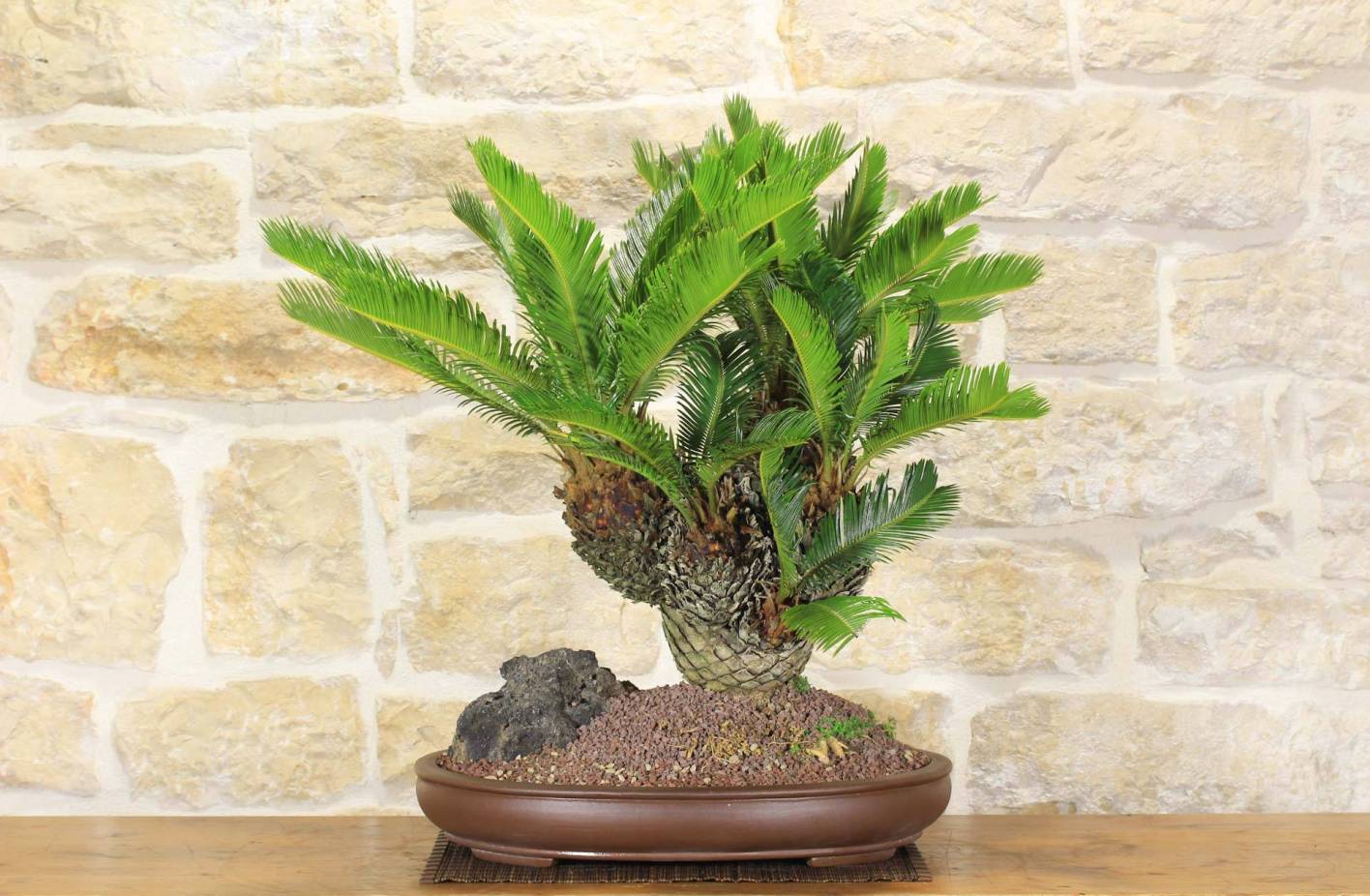
Cycas Revoluta Bonsai: Care, Growing, Compact Leaves

CYCAS REVOLUTA BONSAI

The Cycas Bonsai: A Living Fossil in Your Pot

The Cycas Revoluta (or "Sago Palm", although it is not a true palm) is a plant that takes us back to the age of the dinosaurs. In Japan it is highly valued as a bonsai (known as Sotetsu) for its exotic look, its sculptural trunk resembling a pineapple and its crown of dark green pinnate leaves. It is not a tree in the traditional sense: it does not branch like a maple or a pine. Its beauty lies in the rosette of leaves and in the rugged trunk. It is the perfect plant for anyone who wants a tough, sculptural bonsai that grows at a calm, zen pace.

Origin & species

Native to southern Japan (Ryukyu Islands) and China, the Cycas is a primitive Gymnosperm. It is a dioecious, extremely slow-growing plant. Its resilience is legendary: it is a true botanical survivor, able to recover even after periods of neglect, provided it is not allowed to rot.

Position and microclimate

The Cycas loves light and warmth.
Ideal position: Full sun. The more sun it gets, the shorter, stiffer and more compact the leaves will be (the bonsai grower's goal).
If you keep it in the shade, the leaves will stretch out enormously ("drawing up"), becoming weak and unattractive. In summer it enjoys high temperatures and does not mind scorching heat, as long as there is ventilation.

Watering

The golden rule is: better dry than soaked.
The trunk of the Cycas acts as a water reserve. Water generously only when the soil mix has been completely dry for several days. In winter, if kept cold, watering should be almost suspended (lightly moistening once a month is enough). Excess water quickly leads to rot of the roots and the collar.

Water quality

It is not fussy. Tap water is fine. However, if the water is very hard, over time you may notice difficulty in absorbing micronutrients such as Manganese or Iron, which are essential for keeping the leaves dark green.

Substrate

Drainage must be extreme. Do not use pure peat-based soils.

  • Recommended mix: 60% Volcanic Lapillus (excellent for structure and micronutrients), 30% pumice and 10% general-purpose soil mix or humus.
  • Lapillus is particularly suitable for the Cycas because, besides draining, it releases useful minerals and its reddish colour creates a pleasant contrast with the dark trunk.

Repotting

Given its fleshy roots and slow growth, it is repotted every 3-5 years.
When: Late spring or early summer (May-June), when it is warm.
Do not cut the roots back too hard. Remove only the rotten or dried ones and slightly shorten the longest ones so they fit in the pot. Wear gloves: the roots are delicate, but the plant can be spiny at the base of the leaves.

Fertilizing

It is a plant that eats little but wants quality. Use a solid slow-release organic fertilizer from spring to autumn.
Important: The Cycas often suffers from Manganese and Iron deficiency (leaves yellowing in patches). Supplement once a year with specific micronutrients or a greening product.

Flowering and fruiting

In a pot this is a very rare and spectacular event that occurs only on very old plants. The male reproductive structure looks like a large elongated cone, the female one like a feathery sphere at the centre of the rosette. Enjoy the structure of the plant; the flowers are a bonus that perhaps your grandchildren will see.

Managing the crown (pruning)

The Cycas is not pruned like a tree (there are no branches to shorten).
Cleaning: Cut off at the base the old, yellow leaves in the lower part of the rosette.
Reducing leaf size: If you want short, bonsai-like leaves, apply the technique of total defoliation in late spring (May/June). All the leaves are cut away. Stimulated by the summer sun, the plant will produce a new crown of leaves that will be shorter and more compact than the previous ones.

Wiring & bending

The trunk cannot be bent (it is rigid). Wire is rarely used.
Sometimes wire is used to slightly lower the new leaves while they are opening and still soft, to give a more graceful "mushroom" shape, but be careful: the leaves mark very easily. Use thick, soft wire.

Diseases and pests

Public enemy number one is the scale insect (particularly the white scale insect). It attaches under the leaves and sucks the sap. Since the leaves are tough, you can remove it mechanically with a brush and treat with white oil or specific products. Watch out for root rot too (too much water).

Winter & protection

The Cycas can stay outdoors in southern Italy. In the north it withstands down to -2°/-3°C for short periods if the soil is dry, but it is better to shelter it in a cold greenhouse or wrap it well with fleece. In a hard frost it loses its leaves (they dry out), but the trunk often survives and flushes out new growth in summer.

Yearly calendar

  • January-February: Complete rest, almost no water.
  • March-April: Awakening, remove leaves damaged by winter.
  • May-June: Repotting, total defoliation (for experts), fertilizing.
  • July-August: Full sun, water as needed (let it dry out).
  • September: Autumn fertilizing.
  • October-December: Preparation for winter, preventive scale insect treatment.

Useful products for this bonsai


Frequently asked questions about Cycas

Why have the leaves turned yellow with small spots?
If they are yellow dots that later merge, in 90% of cases it is a red spider mite attack or a manganese deficiency. If instead the yellowing starts from the tips, it is often excess water or iron deficiency. Check carefully under the leaves for pests.

My Cycas is not producing new leaves this year, why?
The Cycas is slow. Sometimes it skips a year (a "flush") and produces no new leaves, especially if it has been repotted recently, or has had little sun or little fertilizer. Be patient: as long as the trunk is firm, the plant is fine.

Is it poisonous to dogs?
Yes, highly toxic. All parts of the plant, especially the red seeds, are poisonous if eaten by dogs or cats. Keep it out of their reach.

404 Error

This page is no longer among our branches.

The page you are looking for may have been moved, removed, or is no longer available. But your next bonsai, accessory, or gardening item is still here waiting for you.

Explore the main categories or use the search below.
404

No problem: we will help you quickly find bonsai, pots, accessories, and useful content.

A reference point for bonsai and gardening lovers

Quickly find bonsai, gardening items, pots, accessories, and useful content to better take care of your plants.

Explore the catalog