
€390.00

Home
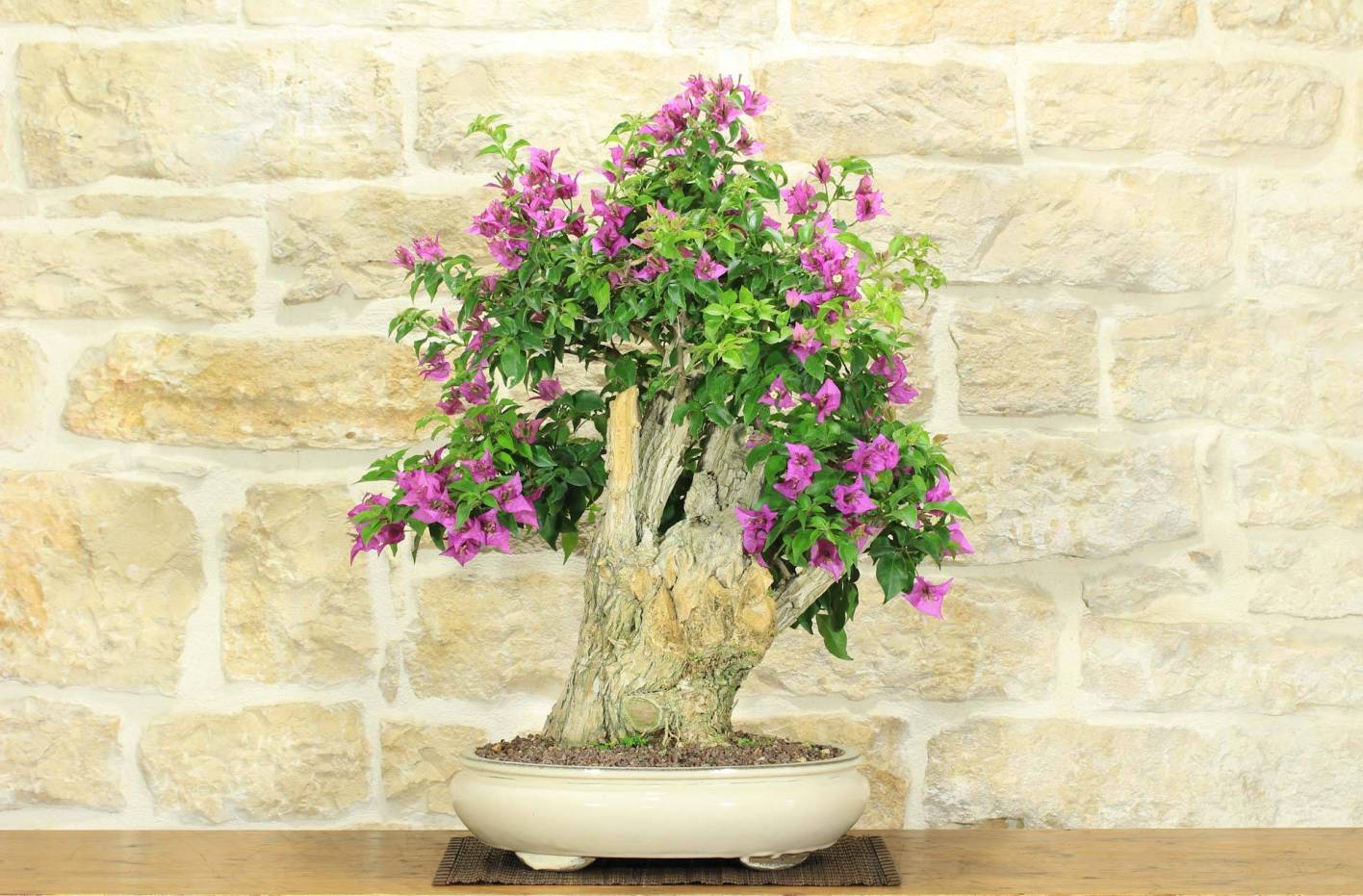
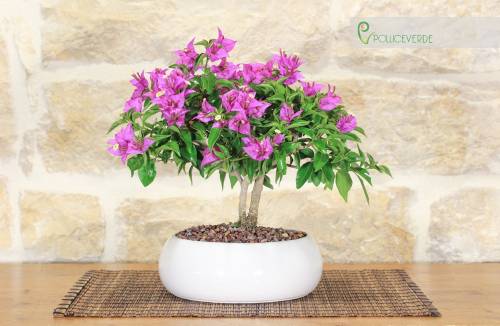
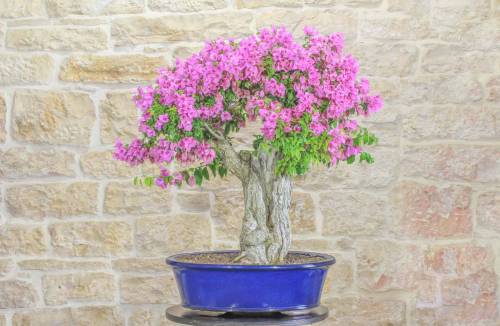
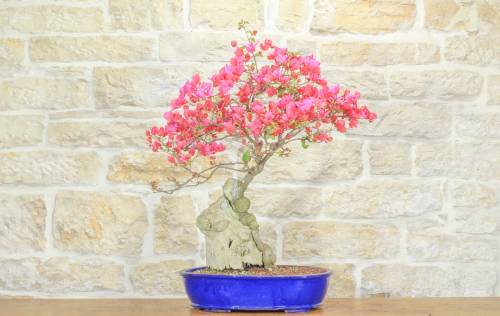
The Bougainvillea (family Nyctaginaceae) is the undisputed queen of the Mediterranean summer. If you are looking for a bonsai that stands out for the vividness of its colours, this is the right choice. A small detail that always catches beginners off guard: what we call the coloured "flowers" (pink, purple, red or orange) are in fact bracts, that is, modified leaves. The true flowers are those small white tubes in the centre. It is a "lively" plant that needs sun, heat and a firm hand to be tamed, but it pays you back with unique displays.
Native to the tropical forests of South America (mainly Brazil), Bougainvillea is a climbing or shrubby plant. In bonsai work Bougainvillea glabra (more compact) or Bougainvillea spectabilis are often used. Being a tropical species, its metabolism is tied to warmth: it loves our summers but fears our harsh winters.
There are no half measures here: Bougainvillea wants direct sun. The more sun it gets, the more colourful and abundant the bracts will be.
Shade inhibits flowering and causes the growth to stretch and become weak. Only in cases of extreme heat (above 40°C in a small pot) can you give it slight shelter during the central hours, but it is one of the few plants that laughs in the face of the August sun.
Water management is the secret to flowering. Bougainvillea is a plant that, if pampered too much with water, produces nothing but green leaves.
Water generously, but let the soil mix dry out well between one watering and the next. Slight water stress (letting the soil dry properly) often stimulates flower production. Be careful though: if the leaves wilt too much, water immediately.
It dislikes limescale and very hard water, which in the long run causes chlorosis (yellowing of the leaves). If you can, use rainwater or slightly acidify tap water by letting it stand. If you see the leaves turning pale green with dark veins, the plant is asking for iron (iron chelate).
It needs a free-draining soil to avoid root rot, which is its Achilles heel, but slightly more acidic than for other species.
Forget the rules that apply to our native plants. Being tropical, Bougainvillea is repotted when it is warm, in late spring (May-June), when night temperatures are steadily above 15-18°C.
Caution: the roots are fragile and fleshy. It does not tolerate drastic reductions of the root system. Be gentle and use a slightly deeper pot if possible.
It is a hungry plant. During the growing season (May to September) it should be fertilized regularly.
To encourage flowering, use a fertilizer higher in Potassium (K) and Phosphorus (P) and lower in Nitrogen (N) from late spring onwards. Excess nitrogen will give you a beautiful green bush, but without a trace of colour.
Flowering occurs on new shoots. To keep it compact, you need to pinch back the branches that grow too long. After the first summer flowering, if you prune lightly and fertilize, you may get a second flowering in autumn.
Heavy pruning is done in late winter/early spring, before growth resumes. Bougainvillea heals badly and slowly: always protect large cuts with cut paste and try not to make huge cuts on the main trunk unless strictly necessary, because the wood tends to shrink back.
It is a species that grows fast and throws out long whip-like branches. During the summer shorten the over-long branches to keep the shape, cutting back to 2-3 nodes. Remember that the flowers appear at the tip of the new shoots: if you keep pinching everything, it will never flower. You have to find the balance.
Young branches are very flexible, almost herbaceous, but take care: they lignify quickly and become hard and brittle.
Watch out for the thorns! A thorn often hides in the leaf axil and can make wiring painful. Apply the wire when the branch is still green but starting to harden. Check often, because it grows fast and the wire bites in quickly.
If grown in sun and fresh air, it is healthy. However:
This is the critical point. Bougainvillea does not tolerate frost.
In northern Italy it must be moved into a heated greenhouse or indoors (in a very bright, not too warm room) as soon as temperatures drop below 5-7°C. In the south it can stay outside, but in a position sheltered from cold wind and possibly covered with horticultural fleece on the coldest nights. If it loses its leaves in winter do not worry too much, it is a defence mechanism; it will flush out new growth in spring.
Why does my Bougainvillea make plenty of leaves but no flowers?
It is probably getting too little sun or too much nitrogen fertilizer. Move it into full sun and stop the nitrogen in favour of a flowering fertilizer (with potassium). Sometimes leaving it a little "dry" for a few days stimulates flowering.
It has lost all its leaves in winter, is it dead?
Not necessarily. If the wood, lightly scratched with a fingernail, is still green underneath, it is alive. It is a reaction to cold or poor light. In spring, with the warmth, it should flush out new growth. Be careful not to drown it with water while it is leafless.
How can I thicken the trunk?
Bougainvillea thickens slowly in a pot. The trick is to let sacrifice branches grow (several metres long) for one or two seasons without cutting them, fertilizing heavily. This will draw sap and widen the base.
Can I wire old branches?
Not advisable. Old Bougainvillea branches are stiff and snap clean off without warning. It is better to work with directional pruning, or to wire only young branches that are still green or semi-lignified.
There are 4 products.