
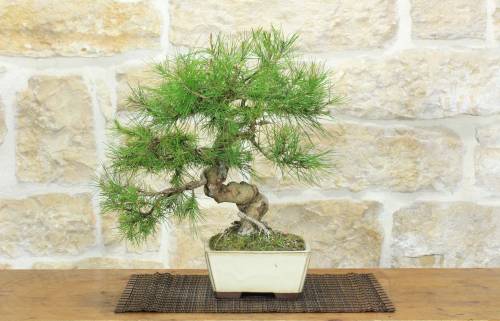
Blackthorn Bonsai: Full Guide, White Flowers, Blue Fruit

BLACKTHORN BONSAI

Blackthorn Bonsai: The Angular Beauty of Winter

The Blackthorn (Prunus spinosa), also known as sloe, is a bonsai that embodies wild toughness. In nature it is the shrub that forms impenetrable hedges, but in a pot it becomes a work of art thanks to its blackish bark (hence the name "Blackthorn"), which turns rugged with age, and to its branches growing in a zig-zag pattern, often ending in sharp thorns. It is prized for its early blossom, a cloud of white flowers appearing on bare branches in late winter, followed by small blue-black fruit with a waxy bloom (sloes) in autumn.

Origin & species

Native to Europe, western Asia and north-western Africa, it is a widespread indigenous plant. It belongs to the Rosaceae family. It is an extremely tough and adaptable deciduous shrub, able to survive in difficult conditions. In bonsai it is valued for its ability to build fine, intricate ramification and for the aged character it takes on quickly.

Position and microclimate

The Blackthorn loves full sun.
Direct sunlight is essential for two reasons: it encourages abundant flowering and keeps the internodes short, preventing branches from becoming too long and weak.
It fears neither wind nor cold. In summer it tolerates heat well, but in a small pot it is better to shade it slightly during the hottest hours, so that the soil mix and the roots do not dry out too quickly.

Watering

It is a vigorous plant that drinks regularly.
Water generously when the soil mix starts to dry on the surface. In summer never let it run short of water, especially when it is carrying fruit.
During flowering, avoid overhead watering on the flowers: water would make them rot or drop early, compromising the set of the sloes.

Water quality

It is extremely hardy.
It tolerates tap water, even hard water, without problems. In nature it is used to heavy and calcareous soils as well, so reverse-osmosis water is not required.

Soil mix

It needs a substrate with good drainage but also with a certain "body".

  • Recommended mix: 50% Akadama (for fine roots), 30% pumice and 20% general-purpose soil or humus.
  • The organic component helps sustain vigorous growth and fruiting.

Repotting

Carry it out in autumn (after leaf fall) or in late winter (February-March), preferably after flowering but before the leaves open.
Repot every 1-2 years for young trees, every 2-3 years for mature ones.
The Blackthorn has a powerful root system that suckers freely (it produces many suckers at the base). When repotting, remove unwanted suckers and shorten the thick roots.

Fertilizing

Feed regularly from spring to autumn.
Use solid organic fertilizer. In spring, once the fruit has set, provide balanced nutrition to support the foliage. In autumn, switch to a potassium-rich fertilizer to harden the wood and prepare next year's flower buds.

Flowering and fruiting

It flowers very early, often in February-March, on bare black branches. The flowers are white, small and numerous.
The fruits (sloes) are spherical blue-black drupes covered with a waxy bloom. They ripen in autumn and stay on the tree for a long time. They are very sharp if eaten raw, but decorative.
Tip: if the bonsai is young, remove most of the fruit so as not to exhaust the plant.

Structural pruning

Carry it out in winter when the tree is bare.
The Blackthorn tends to produce untidy, tangled branches. You need to work decisively to select the primary branches and open up the canopy.
Mind the thorns! Wear sturdy gloves and, if necessary, cut off the tips of the thorns so you can work safely.

Maintenance pruning

During the growing season the plant produces vigorous (often vertical) shoots. Shorten them regularly to 2-3 nodes once the base starts to lignify.
This ongoing work is essential to keep the shape and to encourage inner ramification, otherwise the tree will turn into a shapeless bush.

Pinching

On strong apical shoots you can carry out pinching with your fingers in spring, to check growth and encourage denser growth.

Wiring & bending

Young branches are flexible but become stiff and brittle very quickly.
Wiring is done in spring or autumn. The bark is dark and rough, but the wire can still bite in if growth is fast. Check often. For older branches, use guy wires.

Pests and diseases

  • Aphids: they attack the tender shoots in spring.
  • Red spider mite: in summer, in hot dry weather.
  • Leaf curl or shot hole: fungi that spot the leaves. Preventive copper treatments in winter are recommended.
  • Caterpillars: they can eat the leaves (the butterfly Thecla betulae lays its eggs on Blackthorn).

Winter & protection

It is an outdoor tree, very frost resistant.
It needs no particular protection, except in case of late frosts that could burn the newly opened flowers. In that case, shelter the plant for a few nights.

Yearly calendar

  • January: copper treatment, pruning on bare wood.
  • February-March: flowering, repotting (after the flowers).
  • April-May: fertilizing, aphid control, pinching.
  • June-July: plenty of water, pruning in leaf.
  • August: summer rest.
  • September-October: autumn fertilizing, sloes ripening.
  • November-December: leaf fall, dormancy.

Useful products for this bonsai


Frequently asked questions about Blackthorn

Can I eat the sloes?
Yes, but they are very sharp and astringent (they pucker the mouth) if eaten raw straight after picking. They become sweeter if picked after the first winter frost. They are often used to make liqueurs (sloe gin).

Why does it have thorns?
It is a natural defence mechanism. The short branches often end in a thorn to protect the plant from grazing animals. In bonsai you can trim the thorns back to work more comfortably.

Why does it produce so many suckers at the base?
That is its nature. The Blackthorn spreads by sending up new stems from the roots. Remove them regularly if you want to keep a single-trunk form, or use them to create a group planting or a raft style.

404 Error

This page is no longer among our branches.

The page you are looking for may have been moved, removed, or is no longer available. But your next bonsai, accessory, or gardening item is still here waiting for you.

Explore the main categories or use the search below.
404

No problem: we will help you quickly find bonsai, pots, accessories, and useful content.

A reference point for bonsai and gardening lovers

Quickly find bonsai, gardening items, pots, accessories, and useful content to better take care of your plants.

Explore the catalog