
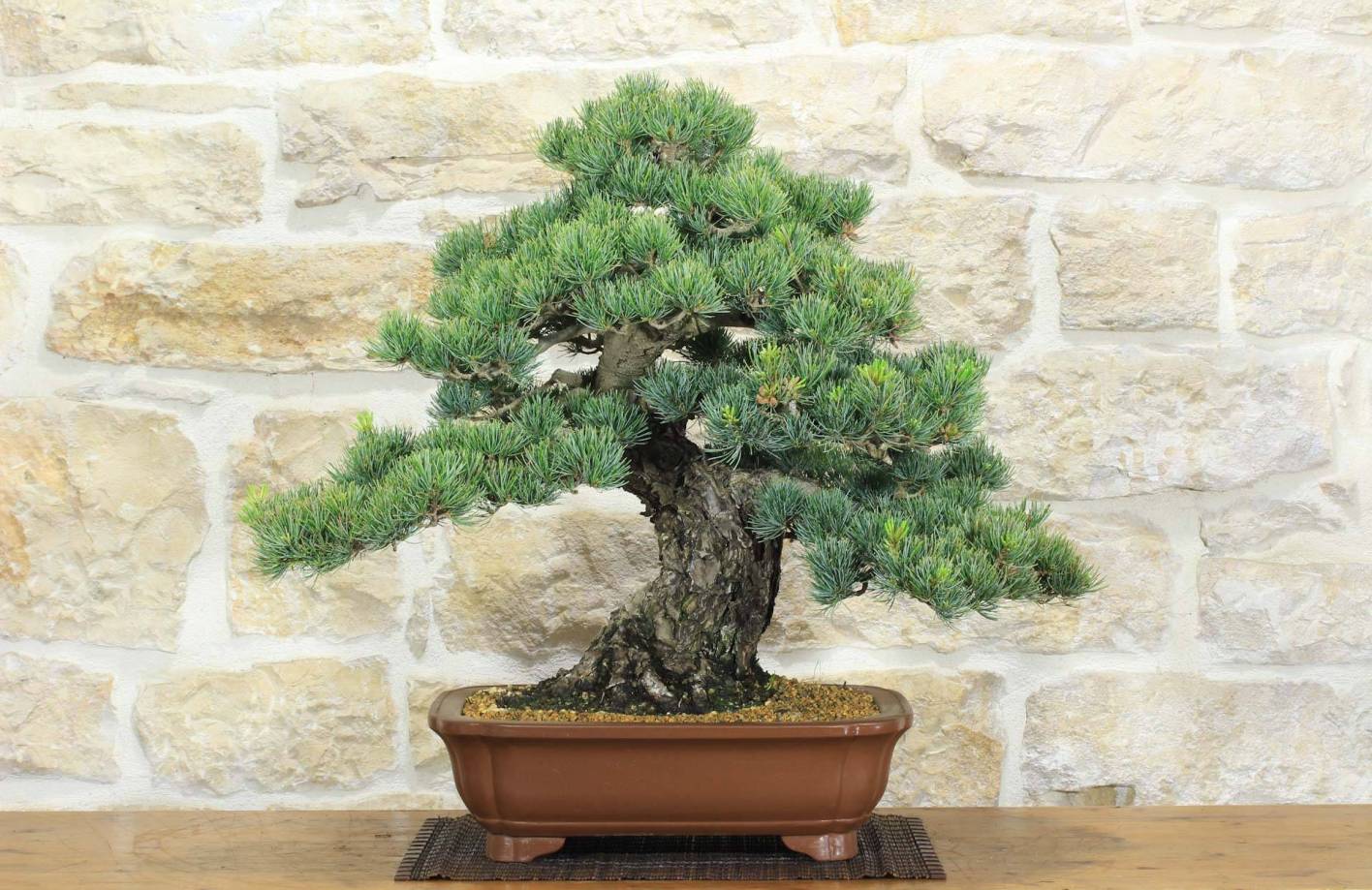
Japanese White Pine Bonsai: Full Care Guide (Goyomatsu)

JAPANESE WHITE PINE BONSAI

The Japanese White Pine Bonsai: Feminine Elegance (Goyomatsu)

The Japanese White Pine (Pinus parvifolia or pentaphylla) is known in Japan as "Goyomatsu". If the Black Pine is the "King" (masculine strength), the White Pine is the "Queen" (feminine elegance). It is recognised at once by its needles gathered in bundles of five (hence "pentaphylla"), which are short, soft and of a blue-green colour with a silvery band on the inner side. It is a refined tree, slower growing and more compact than the Black Pine, much loved for its ability to build dense, flat foliage pads of extraordinary beauty.

Origin & species

Native to the mountains of Japan, it is a tree that often grows at high altitude or on rocky ground. This origin makes it extremely cold hardy. The most common and appreciated variety in bonsai is Miyajima (often grafted onto Black Pine to give it vigour), famous for its short needles and the horizontal growth of its branches.

Position and microclimate

It likes full sun and open air.
Sun exposure (at least 4-6 direct hours) is needed to keep the bluish colour of the needles and to prevent fungal diseases. However, compared with the Black Pine, it tolerates partial shade a little better in very hot regions, since its needles are more delicate and can scorch under the fierce August sun if the tree is in a small pot.

Watering

The White Pine fears standing water more than anything else.
Water only when the soil mix is well dried out. Check with your finger below the surface. Excess water quickly leads to yellowing needles and rotting of the fine roots. It does enjoy misting over the canopy (in the evening in summer), which cleans the stomata and hydrates the needles.

Water quality

It prefers soft water, but adapts well to tap water. What matters is that it is not too brackish or chalky, so as not to alter the pH of the substrate over the long term.

Substrate

Drainage must be impeccable.

  • Recommended mix: 50% Kiryuzuna (or medium-grain pumice) and 50% Akadama.
  • Kiryu is the specific Japanese substrate for pines: it is hard, it does not break down and it guarantees oxygen to the roots for years. If you do not have it, pumice is an excellent substitute.

Repotting

It is repotted rarely: every 3-5 years (or even longer for mature specimens), in spring (April), when the buds begin to move.
Here too the golden rule of conifers applies: do not wash the roots. Preserve the mycorrhiza (the white symbiotic fungus) and leave part of the old root ball in the centre, otherwise the tree may die of shock.

Fertilizing

Feed with solid slow-release organic fertilizer.
Feed well in autumn (September-November) to prepare the tree for winter and for the following bud break. In spring, fertilize lightly. If you want very short needles, reduce the spring fertilizer while the candles are extending.

Flowering and fruiting

It produces cones that can stay on the tree for years. They are very decorative, short and stocky. However, producing cones uses a lot of energy: on an exhibition tree or one in training, it is better to remove them or leave just one as an aesthetic detail.

Structural pruning

Major design work and the removal of large branches are done during winter dormancy.
The White Pine heals slowly and its resin is less abundant than the Black Pine's, but sealing the cuts with cut paste is still essential to stop pathogens entering the wood.

Maintenance pruning (shoot selection)

Unlike the Black Pine, the White Pine is NOT defoliated and the candles are NOT cut back to zero (Mekiri) as a rule, because it struggles to produce a second flush in the same year.
Maintenance is based on selection: if a branch carries too many buds, only 2 are left (in a "V" shape).

Pinching (Metsumi)

In spring, as the candles extend, the strongest ones are pinched (broken off with the fingers), reducing them by 1/3 or 2/3. This slows growth and keeps the shape compact without stressing the tree too much.

Wiring & bending

The branches of the White Pine are extremely flexible and can be bent into very sinuous shapes.
The best time is autumn/winter. Use aluminium or copper wire. Since growth is slow, the wire can stay on for a long time (even 1-2 years), but always check that it is not marking the smooth bark.

Diseases and pests

  • Red spider mite: causes pinpoint yellowing of the needles.
  • Mealybug: hides between the needle bundles.
  • Woolly aphid: white tufts on new shoots.

Winter & protection

Extremely cold hardy (it is a high mountain tree). It can stay outdoors all year round. Protect the pot only in case of prolonged extreme frost, to safeguard the pot itself and the fine roots.

Yearly calendar

  • January-February: structural pruning, wiring.
  • March-April: repotting (if needed), start of light fertilizing.
  • May: candle pinching (Metsumi).
  • June-July: pest checks, careful watering.
  • August: cleaning out old needles (Momiage) to let light in.
  • September-October: autumn fertilizing (important!).
  • November-December: dormancy.

Useful products for this bonsai


Frequently asked questions about the White Pine

Why is it called "Pentaphylla"?
From the Greek "penta" (five) and "phylla" (leaf). If you look at a bundle of needles, you will count exactly five coming out of the same sheath. The Black Pine has two, the Ponderosa Pine has three.

Can I cut the candles as on the Black Pine?
Better not, or only if you are very experienced and the tree is very strong. The White Pine is weaker; if you cut everything off (Mekiri), you risk it not pushing anything back and the branch dying. Stick to pinching them (shortening them) or selecting the buds.

Why is it grafted?
White Pines (Miyajima variety) are often grafted onto Black Pine roots (stronger and more vigorous). If you see a change in the bark at the base of the trunk, that is the graft point. It is an advantage, because it combines the beauty of the White Pine with the strength of the Black.

404 Error

This page is no longer among our branches.

The page you are looking for may have been moved, removed, or is no longer available. But your next bonsai, accessory, or gardening item is still here waiting for you.

Explore the main categories or use the search below.
404

No problem: we will help you quickly find bonsai, pots, accessories, and useful content.

A reference point for bonsai and gardening lovers

Quickly find bonsai, gardening items, pots, accessories, and useful content to better take care of your plants.

Explore the catalog