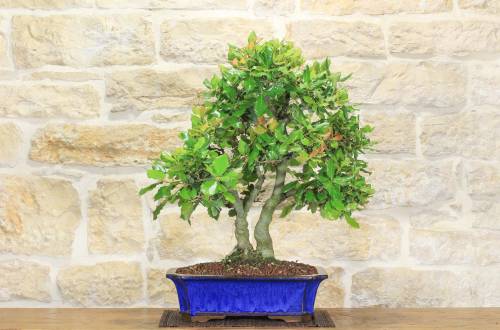

€390.00

Home
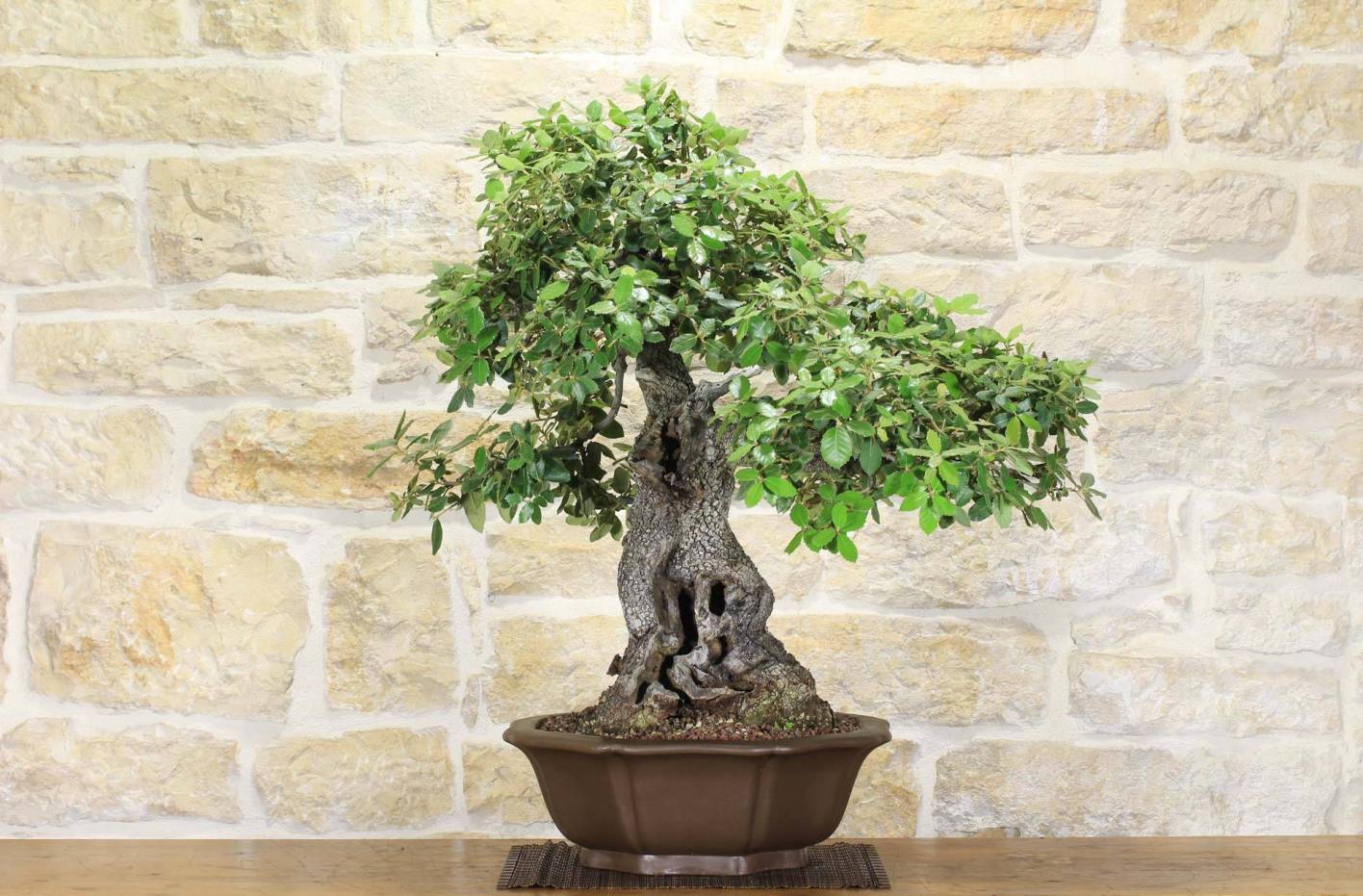
The Holm Oak (Quercus Ilex) is the king of the Mediterranean scrub. Unlike deciduous oaks (such as the Downy Oak), the Holm Oak is evergreen. It has leathery leaves, glossy dark green above and silvery beneath, often spiny on young specimens. It is a bonsai that conveys strength, stability and longevity. Ideal for those who like the naturalistic style and want a tree that represents our coastal and hill landscape.
Native to the Mediterranean basin, it is a tree that can become monumental. Its wood is extremely hard and the bark becomes finely scaly and dark with age. It is a slow but relentless grower.
Strictly full sun.
Light keeps the foliage compact and makes the leathery leaves work properly. It stands up very well to wind and salt spray.
In summer it does not suffer from heat, but take care that a small pot does not overheat, or the roots will cook.
As a good Mediterranean plant, it tolerates drought better than a Maple, but do not overdo it in a pot.
Water when the soil mix is dry. Absolutely avoid prolonged waterlogging, which encourages root rot (its weak point). In winter water sparingly, just enough to keep the soil from drying out completely.
It tolerates hard water without problems. It is a tough plant used to alkaline soils, so tap water is perfectly fine.
It needs excellent drainage to avoid root fungi.
The critical moment. Oaks do not like having their roots disturbed too much.
When: Late spring (May), when the new buds are opening and the tree is active. Never in winter.
Do not bare-root the plant. Always leave some old soil under the trunk, as it holds the mycorrhizae (symbiotic fungi essential to the health of the oak).
Feed with slow-release organic fertilizer in spring and autumn. The Holm Oak responds well and thickens its canopy. In autumn use fertilizers rich in potassium to harden the wood ahead of winter.
It produces acorns. On bonsai they are rare on young plants, but on mature specimens they are a fine autumn detail. Remember that producing acorns costs energy: if the plant is weak, remove them as soon as they form.
Carried out during winter dormancy (January-February). Holm Oak wood is extremely hard: use well-sharpened tools.
Large cuts struggle to close over perfectly; using cut paste is therefore mandatory, to prevent the wood from shrinking back or being attacked by fungi.
During the growing season the plant tends to produce very vigorous shoots at the apex. Shorten them regularly to redistribute strength to the lower and inner branches.
In June, on plants in perfect health, defoliation (total or partial) can be carried out to reduce leaf size and encourage fine new ramification.
This technique is essential to keep the shape. As soon as the new shoot has produced 4-5 leaves and the shoot starts to lignify (turning from green to light brown), cut back leaving only 2 leaves. This will push the axillary buds to produce new forked shoots.
Holm Oak wood is stiff and barely elastic once mature.
Wiring is best done on young green branches, which are still workable. To lower large old branches, the best technique is the use of guy wires, which bend the branch gradually without risking sudden breaks.
In southern and central Italy it lives outdoors all year round. In the north, if temperatures stay steadily below -5°C, it is better to move it into a cold greenhouse or protect pot and canopy with horticultural fleece, especially if the bonsai is in a small pot that freezes easily.
Why do the new leaves have a white dust on them?
It is powdery mildew. The Holm Oak suffers from it a great deal in spring when there is humidity. Remove the worst affected leaves and treat immediately with a specific fungicide, giving the plant more sun and air.
Can I collect a Holm Oak in the wild (yamadori)?
It is very unlikely to survive. Oaks have a deep taproot and few fine roots near the trunk. If you cut the taproot all at once, the plant often dies. It is better to buy one from a nursery or start from seed (acorn).
Why aren't the leaves spiny?
The Holm Oak shows "heterophylly": the low, juvenile leaves are spiny (to defend against grazing animals), while the high, adult ones are smooth. On bonsai the juvenile form is often kept through pruning, but on old plants the leaves naturally tend to become smooth.
There is 1 product.