Home
- BONSAIaddremove
- BONSAI POTSaddremove
- RESIN VASESaddremove
- TROLLIES FOR POTaddremove
- TERRICCIaddremove
- PHYTOSANITARY PRODUCTSaddremove
- FERTILIZERSaddremove
- STORAGEaddremove
- OUTLET
- SEEDSaddremove
- GARDEN PONDSaddremove
- PLASTIC VASESaddremove
- BONSAI PILLSaddremove
- BOTANICAL TIPSaddremove


OLIVE BONSAI
The Olive Bonsai: The Immortal King of the Mediterranean
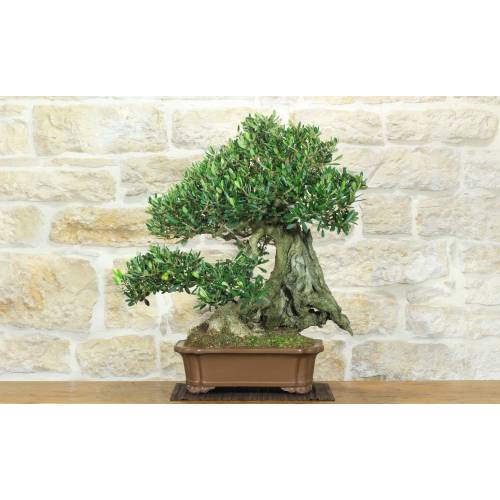
TheOlive tree(Olea europaea) is not just a tree, it is a living monument. In bonsai it represents strength, survival and austere beauty. It is perhaps the most beloved essence among Italian bonsai growers because of its incredible longevity and endurance. What makes the Olive a masterpiece is its bark that becomes wrinkled and sculptural, the wood that, as it dies, creates silvery-colored natural "Jin" and "Shari" (dry wood), and the ability to drastically reduce leaf size with the right cultivation.
Origin & species
Native to the Mediterranean basin, the Olive tree is an evergreen plant.
Two main types are distinguished in bonsai:
Cultivated Olive: The one from which we get oil. It has larger, rounder leaves.
Olive tree (Olea europaea sylvestris): This is the wild olive tree. It is a favorite of bonsai growers because it has naturally tiny leaves, short internodes, and develops much more twisted trunks full of dry wood (sabamiki) than the cultivated variety.
Exposure and Microclimate
The Olive tree demands full sun.
Do not be afraid to expose it to direct rays even in August (except for pots very small). Sun is the only way to get small, compact leaves and short internodes. It loves wind and open air. If kept in shade or indoors, it weakens quickly, elongates branches and becomes easy prey for mealybugs.
Watering
Although drought-tolerant in the wild, it needs regular but controlled watering in pots.
Let the potting soil dry well between waterings. The Olive tree fears waterlogging more than thirst: constantly soggy soil leads to root rot. However, in summer, when it is in full sun, it drinks a lot and should be watered thoroughly.
Water quality
It is a hardy and tolerant plant. It accepts tap water even if it is calcareous, being accustomed to the basic, rocky soils of the Mediterranean. No need to acidify the water.
Substrate
Drainage must be perfect. Olive trees love stony, aerated soils.
- Recommended mix: 60% Pumice (essential for Olive), 30% Akadama (or Lapillus) and 10% Universal Potting Soil.
- Pumice is the secret ingredient for Olive trees: it keeps the right moisture without suffocating the roots and releases useful microelements.
Repotting
This is done in spring (March-April), when the plant begins to move buds.
The Olive tree is very robust: it tolerates even drastic root pruning well (often necessary on harvested specimens, or yamadori). Repot mature specimens every 3-4 years. Use pots not too deep to enhance the base of the trunk (nebari).
Fertilization
Fertilize from spring to fall with slow-release solid organic fertilizer.
If you are working on fine branching and want small leaves, do not overdo the nitrogen. Suspend fertilization in the warmer months (July-August) and in winter.
Flowering and fruiting
It blooms in spring with clusters of small white/yellowish flowers, followed by olives in fall.
Flowers are born on the previous year's branches. If you prune everything in winter, you will not have flowers. Keep in mind that bringing the olives to maturity requires a lot of energy: on a training bonsai it is best to remove them.
Structure pruning
Large cuts are made in late winter. The wood of the Olive tree is extremely hard.
It is essential to use sharp tools and cover the cuts with mastic, although Olive trees tend to compartmentalize well. Unnecessary branches are often not cut away entirely, but debarked to create Jin (dry branches), which add age to the plant.
Maintenance pruning
During the growing season, Olive trees produce long vigorous shoots that should be shortened to maintain the shape of the foliage. Always cut back leaving a couple of leaves; Olive trees grow back very well, even from old wood.
Pruning
To thicken the leaf stages, you shear the tender shoots when they have produced 4-5 pairs of leaves, returning them to 1-2 pairs. This operation is done throughout the spring and summer.
Binding & folding
Caution: olive branches become stiff and brittle very soon.
Wire tying is done on young branches. For bending old, large branches, wire is not enough and you risk breaking them: use ties and proceed in stages, lowering the branch a little at a time over the months.
Diseases and pests
- Mealybug(half peppercorn): Olive tree's No. 1 enemy. Creates dark scuds on the branches.
- Peacock's Eye (Cycloconium): A fungus that creates round spots ("eyes") on leaves, causing them to yellow and fall. It is prevented with copper products and by placing the plant in sun and air.
- Honeydew: A black patina on leaves, a consequence of honeydew from the mealybug.
Winter & protections
In the South and coastal areas it lives outside year-round without problems.
In the North, although hardy, potted roots may suffer if the soil loaf freezes completely for days. Protect the pot with non-woven fabric or put it in a bright cold greenhouse if temperatures fall steadily below -4°/-5°C.
Annual calendar
- January-February: Dry wood processing (Jin/Shari), structure pruning.
- March-April: Repotting, preventive copper treatments.
- May-June: Pruning, fertilizing, full sun.
- July-August: Careful watering, rest.
- September-October: Fall fertilization (PK), cleaning.
- November-December: Winter protection (in the north), liquid jin on dead wood.
Useful products for this bonsai
- Sifted Pumice (The essential substrate for Olive trees)
- Jin liquid (For bleaching and protecting dry wood)
- Biogold fertilizer (High quality solid nourishment)
- Coppered aluminum wire (For setting young branches)
- Healing mastic (To protect cuts)
- Wood gouges (For working Jin and Shari)
Frequently Asked Questions about Olive Bonsai
Why is my Olive tree losing leaves and having round spots?
It is Peacock's Eye (Cycloconium oleaginum), a very common fungus if there is stagnant moisture. Treat with Copper-based products and move the plant immediately to a more ventilated and sunny area.
Can I keep it indoors as furniture?
The Olive tree suffers greatly indoors. It needs the cycle of the seasons and, above all, an amount of direct light that no lamp or window can match. If you keep it indoors, it will survive for a while, but it will lose its leaves and weaken until it dies.
How do you bleach dry wood?
The white part characteristic of bonsai olive trees (Jin and Shari) is obtained by brushing dead wood (clean and dry) with Jin Liquid (calcium polysulfide). This treatment bleaches the wood and protects it from rot. It should be done 1-2 times a year, preferably in summer under the sun.
There are 8 products.