


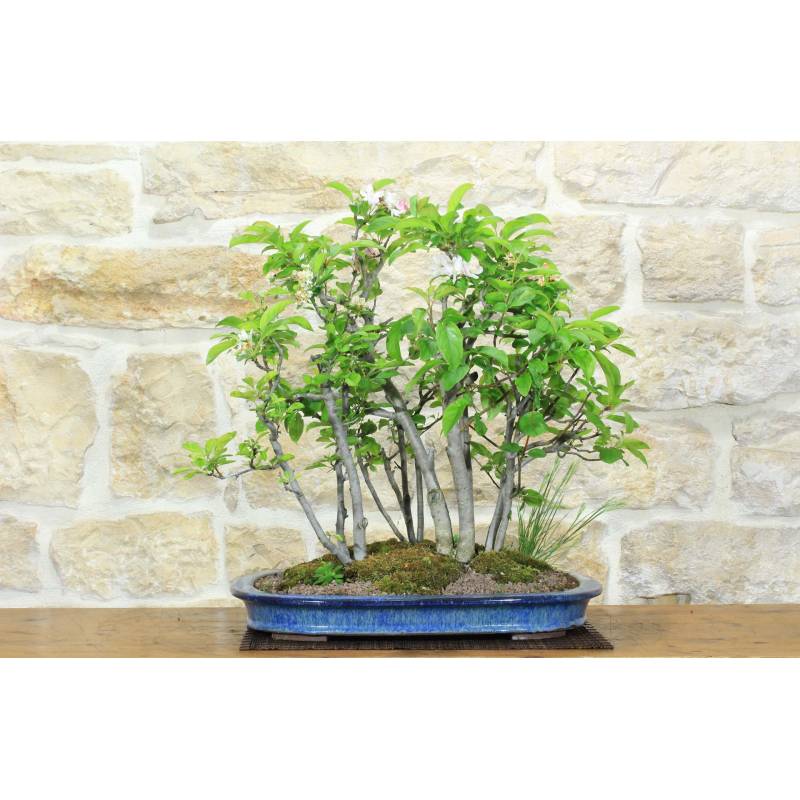


Apple Blossom Grove (5)
Malus floribunda grove with five trunks, pinkish-white blooms in spring. Grove style (yose-ue) in an oval blue glazed ceramic pot.

We pack the bonsai in order to guarantee the life of the plant

Discover Our Guarantee Up To 2500 €

Active Every Day From 09:00 - 18:00
Presentation
This Malus floribunda forest is a truly suggestive composition: five trunks rising from the moss with a naturalness that evokes a small miniature orchard. In spring, the white and pink flowers bloom among the bright green leaves, offering a spectacle that few bonsai can provide with such delicacy. The flowering crabapple is one of the most beloved species in bonsai precisely because of this seasonal alternation – flowers, fruits as small as pearls, autumnal foliage – which makes every period of the year different from the last.
The forest style (yose-ue) amplifies the charm of the species, creating a scene that evokes a corner of the countryside enclosed in a bowl. A plant designed for those looking for something different from a single trunk, a true living landscape.
Technical characteristics
- Botanical species: Malus floribunda (Flowering Crabapple)
- Bonsai style: Forest (yose-ue) with 5 trunks
- Pot: Oval blue glazed ceramic bowl
- Exposure: Full sun, outdoors all year round
- Care difficulty: Medium
How to care for it
Position: The flowering crabapple is an outdoor bonsai in every respect. It needs full sun to bloom abundantly and produce its small decorative fruits. In winter it tolerates the cold well – in fact, it needs it for its vegetative rest – but it is advisable to protect the pot from prolonged frost, perhaps by moving it to a cold greenhouse or sheltering it with non-woven fabric during the coldest periods.
Watering: During the growing season, the Malus is quite thirsty, especially when in full leaf or during flowering. Water when the surface soil begins to dry out, never letting it become completely bone dry. In winter, reduce watering, but without forgetting the plant: the substrate must never dehydrate completely.
Fertilization: Fertilize with a slow-release organic fertilizer from the start of the growing season (March) until late autumn. Before flowering, you can use a fertilizer slightly richer in phosphorus and potassium to encourage abundant buds. Suspend during full bloom and in the hottest months of summer.
Pruning: Structural pruning is carried out in late winter, before the restart. Branches that have flowered should be shortened after the petals fall, leaving 2-3 buds. During the summer, you can pinch back the most vigorous shoots to maintain the compact shape of the forest. Warning: the apple tree flowers on the previous year's branches, so avoid drastic pruning if you want to enjoy the next bloom.
Repotting: Every 2-3 years in spring, just before the vegetative restart. Use a well-draining substrate – pure akadama or mixed with pumice – and do not overdo the root reduction. In a multi-trunk forest, repotting requires a bit more care so as not to disturb the balance between the plants.
To learn more about the care of this species, consult our complete botanical sheet with all the advice from our experts.
Frequently Asked Questions
Q: Does the flowering crabapple forest bloom every year?
A: Yes, spring flowering is one of the most appreciated characteristics of Malus floribunda. To obtain an abundant bloom, it is important to respect the winter rest outdoors, fertilize adequately with phosphorus and potassium in autumn, and not prune the year's branches too much, because that is exactly where the flower buds for the following season form.
Q: Can I keep this bonsai in an apartment?
A: No, the flowering crabapple is an outdoor bonsai that needs the natural cycle of the seasons. Winter cold is essential for dormancy and subsequent flowering. Inside the house, the plant would decline rapidly. Place it on a balcony, terrace, or in the garden, in a sunny and well-ventilated spot.
Q: Are the five trunks of the forest separate plants?
A: Yes, they are five distinct specimens planted together in the same bowl to recreate the effect of a small natural woods. This style – called yose-ue in the Japanese tradition – requires some experience in management, because each plant has its own space and light needs, and must be cared for so that the forest maintains balance and harmony over time.
Q: Do fruits also appear after the flowers?
A: Often, yes. Malus floribunda produces small decorative pomes, similar to red-yellowish beads, which remain on the branches for several weeks and add a further ornamental element. They are not edible but are highly appreciated aesthetically. To encourage their formation, during flowering, you can help pollination with a soft brush.
What is included
- Flowering Crabapple Bonsai (Malus floribunda) 5-trunk forest in an oval blue glazed ceramic bowl — the exact specimen in the photo
- Plant certificate (specimen ID card with species, measurements, and characteristics)
- Reinforced packaging designed to protect the plant during shipping
This is a unique piece: the photo corresponds exactly to the plant you will receive. Being a living plant, its appearance may vary over time due to natural growth, pruning, pinching, or seasonal changes.
- Days of preparation
- 3
- tipo pianta
- FROM FRUIT
| EXPRESS COURIER | EU-ZONE |
| 0 a 100 Kg. | from 0.35 until 5 € for Kg + Additional fix cost (depending to your EU-ZONE) |
| 100 Kg > + | CONTACT US FOR PRICE |
- Add to cart the product.
- Go to Cart
- In the bottom of page "Estimate shipping" and put your country, then the website will give you a


feedback Report comment