

Chilean sphagnum moss for bonsai, 150 g pack


We pack the bonsai in order to guarantee the life of the plant

Discover Our Guarantee Up To 2500 €

Active Every Day From 09:00 - 18:00
What it is and where it comes from
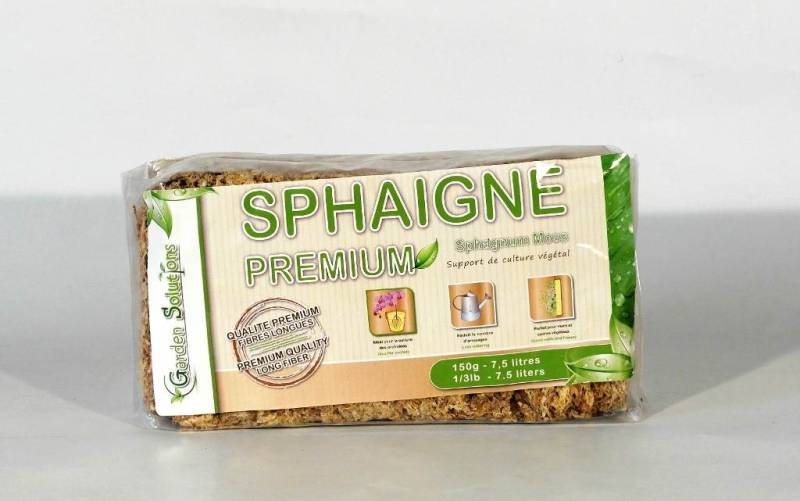
Sphagnum is a moss that is harvested and dried, here in the long-fibre Chilean grade, the one with the longest and toughest strands. It arrives pressed into a dry block, in a 150 g pack. It is a pure organic material, also approved for organic growing under European Regulation 834/2007.
How it behaves in the pot
Only one feature really matters: it holds water. It can absorb up to twenty times its own dry weight, so much so that 150 grams of dry product, once moistened, weigh roughly 3 kg. In hot, dry spells its open-cell structure acts as a reservoir, releasing moisture to the roots gradually rather than all at once.
When it rains, on the other hand, and the substrate stays wet for a long time, the long fibre does not collapse into a paste: air remains between the strands and the roots keep breathing. This dual behaviour is why sphagnum moss has such a place in bonsai cultivation. The material is organic and breaks down over the years, so it should be treated as a surface or corrective element, not as the permanent body of the substrate.
Features
- Long-fibre Chilean sphagnum
- 150 g pack, pressed into a block
- High water retention: up to 20 times its dry weight
- Organic material, approved for organic growing (EC Reg. 834/2007)
Which grade and for which plants
It is not a granulate, it is fibre: you measure it out by hand and, given the modest pack size, it suits targeted work on one or a few plants, from shohin to medium sizes. The most common use is on the surface, spread thinly over the root ball to keep the collar moist and to start off the moss, which roots into the fibre and spreads by itself around the nebari.
Those looking for Chilean sphagnum usually also use it on freshly worked plants, on reduced root systems, on cuttings and air layers, where constant moisture is needed without waterlogging. It is handy on species that suffer in dry conditions and in small pots, which dry out within a few hours in summer. On conifers use it sparingly, as they prefer a drier substrate.
How to use it at repotting
Before use, soak it in water for a few minutes: the block is compressed and dry, and only once wet does it open up and double in volume. Squeeze it lightly, tease it apart with your fingers and separate the tufts, discarding any woody fragments.
At repotting, spread it in a thin layer over the settled substrate, pressing it down just enough to make it adhere. On air layers, wrap it around the cut and secure it with film. One tip: after laying it, water with a fine spray, so the fibre soaks up evenly instead of floating away.
Frequently asked questions
How far does a 150 g pack of Chilean sphagnum go?
The block is pressed and dry, so the real volume only shows after soaking: the fibre swells and 150 grams of dry product, once moistened, come to weigh around 3 kg. For surface covering you only need a little at a time, and it is a quantity suited to a few plants or one air layer.
Can I use it as the only substrate in the pot?
You can, but only in particular situations such as air layers, cuttings or plants recovering with a reduced root system, and in any case in small pots, given the quantity. In the final growing pot it remains a supporting material: being organic it decomposes, and over time it loses the open structure that makes it interesting.
Is it really needed to grow moss?
It helps a great deal. The fibre keeps constant moisture at the surface and gives the spores something to cling to, so the moss takes hold sooner and spreads evenly over the root ball. Keep it wet for the first few weeks, otherwise it dries out and colonisation stops.
What is included
- 1 pack of long-fibre Chilean sphagnum
- Weight: 150 g of pressed dry product
If you prefer to measure out the components yourself, you can build your own mix on the custom soil mix page.
- Days of preparation
- 2
| EXPRESS COURIER | EU-ZONE |
| 0 a 100 Kg. | from 0.35 until 5 € for Kg + Additional fix cost (depending to your EU-ZONE) |
| 100 Kg > + | CONTACT US FOR PRICE |
- Add to cart the product.
- Go to Cart
- In the bottom of page "Estimate shipping" and put your country, then the website will give you a