


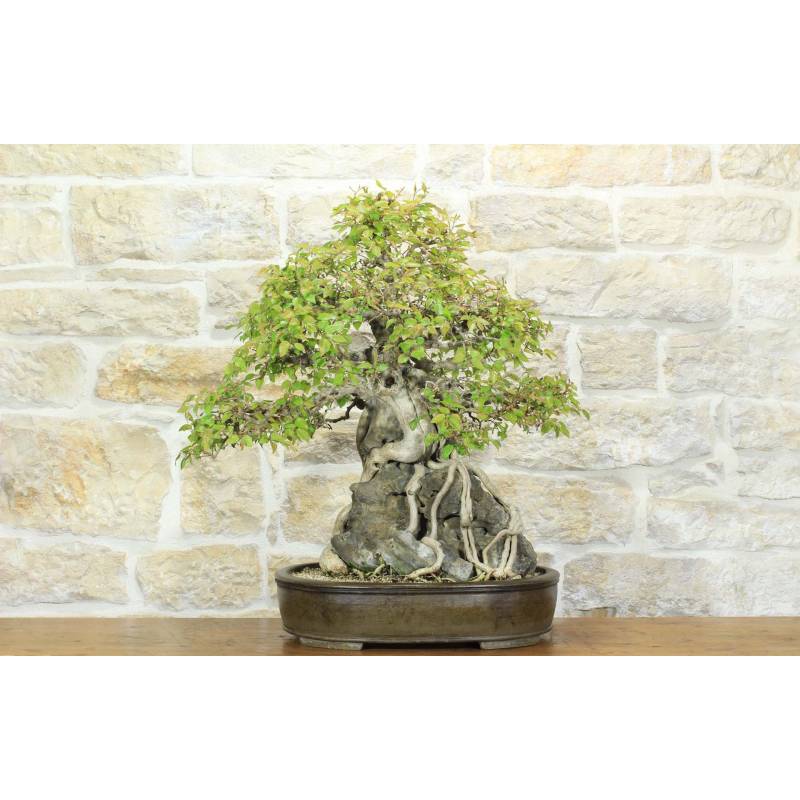


Korean Hornbeam Bonsai with roots on rock (19)

We pack the bonsai in order to guarantee the life of the plant

Discover Our Guarantee Up To 2500 €

Active Every Day From 09:00 - 18:00
Introduction
This Carpinus coreana is a specimen that captures your attention at first glance: the long, sinuous roots wrap around a large natural rock before plunging into the substrate, recreating a miniature mountain landscape that is truly breathtaking. The Korean hornbeam is a species highly valued in bonsai for its small leaves and bark that, over time, takes on a mature, weathered appearance — and in this approximately 40-year-old specimen, these qualities are particularly evident.
The canopy, dense and well-branched, develops with a broad, natural structure that perfectly balances the dramatic movement of the trunk and aerial roots. It is the kind of plant that tells a story every time you observe it from a different angle.
Technical characteristics
- Botanical species: Carpinus coreana (Korean Hornbeam)
- Style: Sekijoju (root over rock)
- Estimated age: approximately 40 years
- Plant height: 72 cm
- Pot: oval natural stoneware, 50 × 38 × h. 11.5 cm
- Overall weight: 35 kg
- Placement: outdoor, partial shade in summer
- Care difficulty: intermediate
How to care for it
Position: the Korean hornbeam is a fully outdoor plant. It loves light, but during the hottest weeks of summer it is advisable to protect it from direct sun during the central hours of the day, especially to avoid burns on the more tender leaves. In winter it tolerates cold, but it is recommended to shelter the pot from the most intense frosts, perhaps with a cold greenhouse or a protective cover.
Watering: the substrate should be kept consistently moist without ever becoming waterlogged. Given the weight and volume of the rock, water should be distributed carefully, ensuring it also reaches the roots that run along the stone. In summer it may be necessary to water even twice a day; in winter the frequency is reduced, but the soil should never be allowed to dry out completely.
Fertilizing: fertilize from the spring growth resumption until late autumn, using a slow-release organic fertilizer. During the hottest months it is preferable to suspend or reduce doses, then resume vigorously in September. A good supply of potassium in autumn helps the lignification of young branches before winter.
Pruning and pinching: structural pruning is carried out in late winter, before the buds open. Shoot pinching is performed throughout the growing season, cutting back to 1-2 leaves when new shoots have developed 4-5 leaves. This constant work is essential to maintain the canopy density and fine ramification that characterize this specimen.
Repotting: repotting is carried out every 3-4 years, in spring, just before the growth resumption. Given the composition with rock, the operation requires particular care: the ideal substrate is a draining mix of akadama and pumice. It is a delicate procedure on a specimen of this size, so it is advisable to rely on expert hands.
To learn more about caring for this species, consult our complete botanical fact sheet with all the advice from our experts.
Frequently asked questions
Q: Do the roots on the rock require special care?
A: The exposed roots on the rock should be protected from overly intense direct sun and excessive dehydration. In summer it is helpful to lightly mist them during the hottest hours. Over time they lignify and become increasingly robust, but during periods of intense heat a little extra attention does no harm. During repotting, it is important to check that they remain firmly attached to the stone.
Q: Does the Korean hornbeam lose its leaves in winter?
A: Yes, Carpinus coreana is a deciduous species and in autumn the leaves take on beautiful yellow-orange tones before falling. The bare winter silhouette reveals the entire structure of the branches and roots on the rock, offering a completely different yet equally fascinating spectacle. It is a plant that provides emotions in every season of the year.
Q: How is a specimen of this size and weight shipped?
A: Every important specimen like this is packed with a dedicated procedure, developed over years of experience with large-sized plants. The plant and the rock are stabilized inside the box with specific materials that protect the trunk, roots, and canopy. The pot is secured to prevent any movement during transport.
Q: Can I keep this bonsai indoors?
A: No, the Korean hornbeam is an outdoor species that needs the natural cycle of the seasons, including winter dormancy with low temperatures. Indoors it would quickly suffer from the lack of adequate light and the constant temperature. It should be placed outdoors — on a balcony, terrace, or in a garden — in a bright and well-ventilated position.
What is included
- Korean Hornbeam Bonsai (Carpinus coreana) on rock in oval natural stoneware pot — exact specimen shown in the photo
- Plant certificate (identity card of the specimen with species, measurements, and characteristics)
- Reinforced packaging designed to protect the plant during shipping
This is a unique piece: the photo corresponds exactly to the plant you will receive. Being a living organism, it may show variations in foliage compared to the image, due to pruning, pinching, or natural seasonal changes.
- Days of preparation
- 3
- tipo pianta
- DECIDUA
| EXPRESS COURIER | EU-ZONE |
| 0 a 100 Kg. | from 0.35 until 5 € for Kg + Additional fix cost (depending to your EU-ZONE) |
| 100 Kg > + | CONTACT US FOR PRICE |
- Add to cart the product.
- Go to Cart
- In the bottom of page "Estimate shipping" and put your country, then the website will give you a


feedback Report comment