


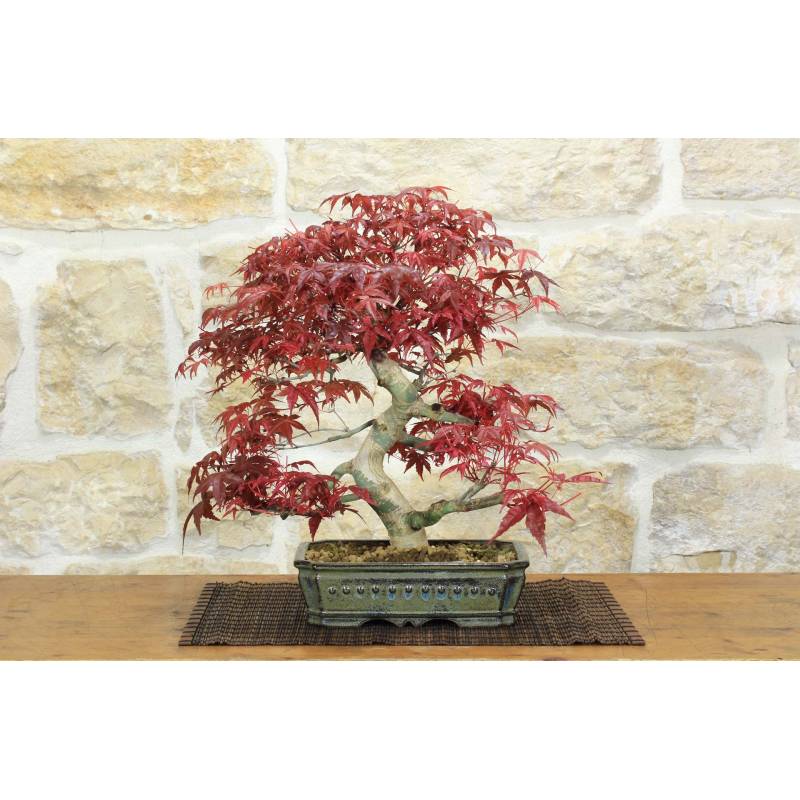


Deshojo Palmate Maple Bonsai (82)

We pack the bonsai in order to guarantee the life of the plant

Discover Our Guarantee Up To 2500 €

Active Every Day From 09:00 - 18:00
Presentation
The Acer Palmatum var. Deshojo is one of the most sought-after varieties in the bonsai world for its extraordinary foliage coloration: a crimson red that in spring reaches an almost unreal intensity, before shifting toward greener tones in midsummer and returning to a blazing display in autumn. This specimen immediately stands out for its sinuous and muscular trunk, with smooth bark in grey-green tones that creates a magnificent contrast with the mass of red leaves. The canopy develops broad and soft, with branches that cascade naturally, giving an elegant silhouette full of character — the kind of plant that catches the eye even from a distance.
Technical characteristics
- Botanical species: Acer Palmatum var. Deshojo
- Bonsai style: Moyogi (informal upright)
- Plant height: 36 cm
- Nebari: 4 cm
- Pot dimensions: 23.5 × 17 × 6.5 cm
- Pot material: Green glazed ceramic
- Overall weight: 2.7 kg
- Exposure: Partial shade, avoid direct sunlight during the hottest hours
- Care difficulty: Intermediate — requires attention to watering and protection from summer heat
How to care for it
Position: The Deshojo maple should be kept outdoors all year round; it is a plant that needs to experience the seasons. In spring and autumn it loves the light, but in midsummer the direct sun during the central hours can burn the leaves, especially in very hot areas. The ideal position is one where it receives morning sun and afternoon shade. In winter, when it loses its leaves, it should be protected from the harshest frosts by sheltering the pot — the roots are more exposed than those of a tree planted in the ground.
Watering: The substrate must never dry out completely: the Japanese maple suffers greatly from drought. Water abundantly when the soil surface begins to dry out, allowing the water to flow out of the drainage holes. In summer, with the heat, you may need to water even twice a day. Misting the leaves on summer evenings helps maintain humidity and prevent leaf burn.
Fertilization: Fertilize from the start of the growing season (March-April) until June with a slow-release organic fertilizer, then stop during the hottest months. Resume in September-October to strengthen the plant before winter dormancy. Avoid fertilizers too rich in nitrogen in spring, or you risk losing the intense red typical of the Deshojo in favor of an early green.
Pruning: Structural pruning is done at the end of winter, when the plant is bare and you can read the branch structure clearly. During the growing season, regularly pinch back shoots by cutting excess pairs of leaves to keep the canopy compact and encourage fine ramification. The Deshojo responds well to partial defoliation in early June, which stimulates a second flush of smaller, intensely red leaves.
Repotting: Repot every 2-3 years, at the end of winter, just before the buds open. Use a well-draining substrate: pure akadama or mixed with pumice in a 70/30 ratio works very well. Prune the roots gently, removing the thicker ones and keeping the fine ones that ensure good absorption.
To learn more about caring for this species, consult our complete botanical guide with all the tips from our experts.
Frequently asked questions
Q: Do the leaves stay red all year round?
A: The Deshojo is famous for its intense spring red. During the summer, depending on the exposure, the color may shift toward bronze or greenish tones — this is entirely natural. In autumn a beautiful red-orange returns before the leaves fall. In winter the plant is bare, and even in this state the structure of the trunk and branches is very captivating.
Q: Can I keep it indoors?
A: No, the Japanese maple is a deciduous tree that needs the cycle of the seasons to stay healthy. It should be kept outdoors, in a position that shelters it from the afternoon summer sun and from the most severe frosts in winter. Indoors it would suffer from lack of adequate light, poor ventilation, and the absence of winter dormancy essential for this species.
Q: How do I protect the leaves from summer burn?
A: The main enemy of the Deshojo is direct sun during the hottest hours, combined with dry wind. Move the plant to partial shade from June to September, water regularly without letting the substrate dry out, and mist the leaves in the evening. A 50% shade net is an excellent solution if you don't have a naturally sheltered spot in your outdoor space.
Q: Is this exactly the specimen I will receive?
A: Yes, the photo shows exactly the plant that will be shipped. As it is a living being, at the time of delivery it may show differences in vegetation compared to the image, due to pruning, maintenance pinching, or natural seasonal changes — for example, you might receive it with fewer leaves or completely bare in winter.
What is included
- Deshojo Japanese Maple Bonsai (Acer Palmatum Deshojo) in a rectangular green glazed ceramic pot — exact specimen shown in the photo
- Plant certificate (identity card of the specimen with species, measurements, and characteristics)
- Reinforced packaging designed to protect the plant during shipping
- Days of preparation
- 2
- tipo pianta
- DECIDUA
| EXPRESS COURIER | EU-ZONE |
| 0 a 100 Kg. | from 0.35 until 5 € for Kg + Additional fix cost (depending to your EU-ZONE) |
| 100 Kg > + | CONTACT US FOR PRICE |
- Add to cart the product.
- Go to Cart
- In the bottom of page "Estimate shipping" and put your country, then the website will give you a


feedback Report comment