




Deshojo Palmate Maple Bonsai (78)
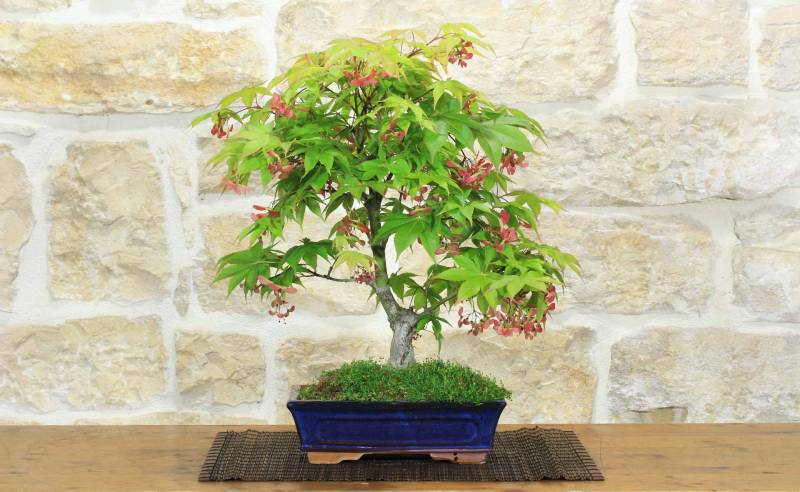
Palmed maple bonsai (Acer Palmatum) Moyogi style, height 33 cm, in rectangular vase Glazed blue 24x15x7.5 cm. Age about 15 years. Unique piece.


We pack the bonsai in order to guarantee the life of the plant

Discover Our Guarantee Up To 2500 €

Active Every Day From 09:00 - 18:00
Presentation
Bonsai of Japanese Maple (Acer palmatum) 33 cm tall, shaped in moyogi style with an upright sinuous trunk and a 4 cm nebari. The photo shows the spring-summer phase, with green foliage and the characteristic red samaras. An outdoor specimen suitable for hobbyists with experience in managing deciduous broadleaf trees.
Technical characteristics
- Botanical species: Acer palmatum (Japanese maple)
- Bonsai style: moyogi (informal upright)
- Plant height: 33 cm
- Nebari: 4 cm
- Age: about 15 years
- Pot: rectangular 24 x 15 x 7.5 cm
- Pot material: blue glazed stoneware
- Weight: 2.9 kg
- Exposure: outdoor, filtered light
- Care difficulty: medium
How to care for it
The Japanese maple is an outdoor species that requires a bright position but sheltered from the direct sun during the central summer hours, which easily burns the leaf margins. In winter it tolerates the cold, but it must be protected from intense frosts and dry winds, especially with the shallow pot of this specimen.
Watering must keep the substrate constantly moist without waterlogging: in spring and summer it may be necessary to water once or twice a day during hot periods, reducing in autumn and limiting to the essential in winter. Water that is too calcareous tends to ruin the foliage over time.
Fertilize from mid-spring to early autumn with a balanced organic fertilizer, suspending during summer heat peaks and during vegetative rest. An excess of nitrogen leads to large leaves and elongated internodes, poorly suited to the bonsai scale.
Structural pruning is carried out in late winter, before budding; during the growing season pinching and partial defoliations are performed to contain the length of the branches and reduce leaf size. Avoid large cuts in midsummer due to the risk of sap bleeding.
Repotting should be done every 2-3 years, at the beginning of spring when the buds swell, using a draining substrate based on akadama with the addition of pumice. On that occasion the thickest roots are shortened and a good nebari is maintained.
To learn more about the care of this species, consult the complete botanical sheet.
Frequently asked questions
Q: Can the Japanese maple be kept indoors?
A: No, it is a deciduous outdoor species that needs the natural cycle of the seasons, including the winter cold for vegetative rest. In an apartment it would suffer from low humidity, the lack of direct light and the absence of the temperature drop, weakening within a few weeks. It must be kept outdoors all year round, with shelter from the strongest frosts and the scorching summer sun.
Q: Why are there those red formations on the tree?
A: They are the samaras, the winged fruits typical of maples, which in this phase take on the characteristic reddish coloration. They are a natural and seasonal phenomenon, a sign of a healthy plant in full vegetative activity. Since this is a living specimen, this aspect can change over time as the season varies.
Q: How do I keep the leaves small?
A: Leaf reduction is achieved with partial defoliation in early summer, which stimulates a second budding with smaller leaves. A measured fertilization, without excesses of nitrogen, and good light exposure also contribute. Pinching of the new shoots keeps the branching compact and the scale of the foliage proportionate to the structure of the tree.
Q: Is the plant I receive identical to the photo?
A: Yes, the photo depicts exactly the specimen that will be shipped. Being a living plant, it may show small differences compared to the image due to growth, maintenance pruning and pinching, or seasonal changes. The green foliage and red samaras visible belong to the phase in which it was photographed.
What is included
- Bonsai of Japanese Maple in a blue glazed stoneware rectangular pot — the exact specimen in the photo
- Plant certificate (identity card of the specimen with species, measurements and characteristics)
- Reinforced packaging designed to protect the plant during shipping
- Days of preparation
- 3
- tipo pianta
- DECIDUA
| EXPRESS COURIER | EU-ZONE |
| 0 a 100 Kg. | from 0.35 until 5 € for Kg + Additional fix cost (depending to your EU-ZONE) |
| 100 Kg > + | CONTACT US FOR PRICE |
- Add to cart the product.
- Go to Cart
- In the bottom of page "Estimate shipping" and put your country, then the website will give you a



feedback Report comment